
Is Error-Awareness Role-Bound? Verifier-Trained Wrongness Probes Barely Transfer to a Model's Own Generation Errors
≈ $42.77 compute
Download paper (PDF, NeurIPS format)
Abstract
Linear probes on residual activations can read whether a language model’s answer is wrong (Alain and Bengio, 2016) (Azaria and Mitchell, 2023) (Marks and Tegmark, 2024), and internal representations can carry information the output omits (Burns et al., 2023). A probe validated in one setting is often assumed to be a general error monitor. We test that assumption across a role boundary. On Llama-3.1-8B-Instruct over 2500 MMLU questions (Hendrycks et al., 2021) (Grattafiori et al., 2024), we train a linear wrongness probe in verifier mode (the model judges a shown candidate answer, with the role held constant so the probe reads wrongness rather than the role) and ask whether it detects the model’s own generation errors on the identical items, against a within-generator ceiling, a reverse-transfer test, a layer sweep, and the cosine alignment of the two probe directions. The verifier wrongness probe is strong within role (AUC 0.823, 95 percent CI 0.812 to 0.834), and generator self-errors are themselves linearly decodable (within-generator ceiling AUC 0.746, CI 0.726 to 0.765), yet the verifier-trained direction transfers to generator self-errors at only 0.603 (CI 0.580 to 0.624) at its best layer and 0.542 at the matched layer, far below the ceiling (transfer gap 0.143) though above a label-shuffle chance of 0.494. Reverse transfer is at chance (0.430), and the verifier-wrongness and generator-wrongness directions are near-orthogonal at every layer (cosine -0.019 to 0.016). Error awareness here is largely role-bound: a genuine generator self-error signal exists, but the verifier-trained wrongness direction captures only a weak shared component of it, and the two error representations are predominantly distinct. The transfer asymmetry and the orthogonal directions argue against a single shared error axis. The practical implication for oversight is that a probe validated as a verifier monitor cannot be assumed to detect a model’s own mistakes (Park et al., 2024) (Pacchiardi et al., 2024).
Introduction
Reading a model’s internal state to tell whether it is about to be wrong is one of the more promising tools for scalable oversight. Linear probes on the residual stream recover truth and error from activations (Alain and Bengio, 2016) (Azaria and Mitchell, 2023) (Marks and Tegmark, 2024), internal representations can encode facts the output contradicts (Burns et al., 2023), and the truth-correlated directions these probes find are causally usable rather than incidental (Li et al., 2023) (Zou et al., 2023). The same machinery detects hallucinations from hidden states (CH-Wang et al., 2024). A natural hope follows: train a wrongness probe once, validate it, and deploy it as an error monitor wherever the model is used.
That hope quietly assumes the internal wrongness signal is one feature, the same whether the model is evaluating a candidate answer or producing its own. The behavioral literature gives reason to doubt it. A model’s ability to judge an answer and its ability to produce one dissociate: critique can outrun generation (Saunders et al., 2022), generation and evaluation competence come apart (West et al., 2024), and intrinsic self-correction frequently fails even when the model could in principle catch its own mistake (Huang et al., 2024) (Stechly et al., 2023) (Kamoi et al., 2024). All of that is measured on outputs. At the representational level, the nearest result shows internal error signals are localized and generalize poorly across tasks (Orgad et al., 2024). Whether the wrongness direction itself is shared across the verifier and generator roles, or specific to each, has not been tested.
We test it directly. On a single instruct model we train a linear wrongness probe in verifier mode, where the model judges a shown candidate answer and the role is held constant so the probe learns that an answer is wrong and not that this is the verifier prompt, and we evaluate that probe on the model’s own generation errors on the identical MMLU questions. Four things make the test sharp. A within-generator probe establishes the ceiling for how well generator self-errors can be linearly decoded at all, so a transfer failure is attributable to the role boundary rather than to undecodable errors. A reverse-transfer test runs the generator-trained probe back on the verifier items. A layer sweep checks whether transfer ever approaches the ceiling at any depth. And the cosine between the two probe directions measures, in the full residual space, whether the verifier-wrongness and generator-wrongness axes are the same direction or different ones. The result is a clean, honest negative with a precise shape: error awareness here is largely role-bound, a real generator self-error signal exists, the verifier-trained direction captures only a weak shared component of it, and the two directions are near-orthogonal.
Related work
A linear probe on the residual stream can read a real internal correctness feature. Probes recover truth and error from activations (Alain and Bengio, 2016) (Azaria and Mitchell, 2023) (Marks and Tegmark, 2024), internal states can encode truth the output denies (Burns et al., 2023), and the directions are causally usable rather than spurious (Li et al., 2023) (Zou et al., 2023), including for hallucination detection from hidden states (CH-Wang et al., 2024). The closest prior result, and the hinge of our question, is that these internal error signals are localized and generalize poorly across tasks (Orgad et al., 2024), which predicts that a wrongness direction learned in one role might not carry to another and motivates measuring exactly that.
Judging and generating are known to dissociate, but only behaviorally. The verifier framing is operational in training answer checkers and process verifiers (Cobbe et al., 2021) (Lightman et al., 2024); critique can exceed answering (Saunders et al., 2022); self-refinement and self-verification presume a model can flag its own errors (Madaan et al., 2023) (Weng et al., 2023); yet intrinsic self-correction often fails (Huang et al., 2024) (Stechly et al., 2023) (Kamoi et al., 2024) and generation and evaluation competence come apart (West et al., 2024). Every one of these reads outputs. None asks whether the dissociation lives in the error representation itself, which is the level a monitoring probe operates at and the level our cross-mode transfer test isolates.
Both outcomes are a priori plausible because internal task encodings can be either context-specific or transportable. In-context learning creates compact task vectors that shift with context (Hendel et al., 2023), while function vectors show some task representations transport across prompts (Todd et al., 2024), so whether a wrongness direction is mode-specific or mode-general is an empirical question rather than a foregone one. The calibration and self-evaluation literature, P(True) and verbalized confidence and their failure modes (Kadavath et al., 2022) (Lin et al., 2022) (Tian et al., 2023) (Xiong et al., 2024) (Guo et al., 2017) (Kuhn et al., 2023), supplies the behavioral signals an internal probe is meant to improve on, and we adopt the AUC-as-detector evaluation and the probing-methodology caveats from that line (Hendrycks and Gimpel, 2017) (Belinkov, 2022).
The stakes are an oversight argument. A monitor that internally separates right from wrong only when the model is grading someone else’s answer, and not when the model is committing its own, is a weak safeguard, and the gap between what a model represents and what it outputs is exactly where deception and unfaithful reasoning live (Park et al., 2024) (Pacchiardi et al., 2024) (Turpin et al., 2023) (Lanham et al., 2023) (Sharma et al., 2023). We ground the empirical setting in MMLU (Hendrycks et al., 2021) and Llama-3.1-8B-Instruct (Grattafiori et al., 2024), and our design mirrors a sibling study that trained a wrongness probe on a model’s honest mistakes and tested transfer to deliberate wrong answers, where apparent transfer dissolved once the eliciting prompt was held constant. That prior sets the prior we test here.
Method
We study Llama-3.1-8B-Instruct on 2500 MMLU questions (Hendrycks et al., 2021). Each question is run under three conditions with the model’s chat template and deterministic greedy decoding, and for each we record the residual-stream activation at the final pre-answer token, the hidden state at generation step zero, for seven evenly spaced layers (8, 12, 16, 20, 24, 28, 32). This is the same last-token readout convention as the sibling study.
In the generator condition the model is shown the question and answers with a single letter; the wrongness label is whether the chosen letter differs from the gold letter, which is the model’s own self-error. The model is wrong on a fraction 0.408 of items, giving 1020 self-errors and 1480 correct answers out of 2500. In the verifier condition the model is shown a question and candidate pair and asked whether the candidate is correct, and we record two candidates per item: the gold answer, whose wrongness label is zero, and a sampled distractor, whose wrongness label is one. Crucially the verifier label is the ground-truth wrongness of the shown candidate, not the model’s own verdict, and both verifier candidates carry the same verifier role, so a probe trained on verifier activations learns that the answer under consideration is wrong with the role held constant rather than learning to detect the verifier prompt itself. This role-held-constant construction is the built-in confound control: it removes the trivial possibility that the probe separates modes by reading the prompt format. The model’s verifier verdict is retained only as an accuracy diagnostic (verifier accuracy 0.710 on these items). Because the generator and both verifier conditions use the identical questions, any failure of verifier-to-generator transfer cannot be item-distribution shift; only the role differs.
All probes are L2-regularized logistic regressions on standardized features with seed 42, fit with item-disjoint stratified group k-fold on the question id so the same item never spans train and test, and reported with bootstrap 95 percent confidence intervals. The chosen layer for each within-mode probe is selected by cross-validation on training folds only. To keep the layer and transfer sweeps tractable the AUC computations run on a label-blind PCA-256 projection of each layer’s activations, which preserves AUC, while the headline direction-cosine is computed in the full residual space. We report five quantities. The within-verifier AUC is a sanity check that verifier wrongness is learnable. The within-generator AUC is the ceiling for detecting generator self-errors, the most a linear last-token probe can extract about the model’s own mistakes. The verifier-to-generator transfer AUC, the headline, trains on verifier activations and evaluates item-disjointly on generator activations, and the transfer gap is the within-generator ceiling minus this transfer. The reverse generator-to-verifier transfer and a label-shuffle chance baseline bound the result from below. Finally the direction cosine is the cosine similarity between the verifier-wrongness and generator-wrongness probe weight vectors in the full residual space, layer by layer: near zero means the two error representations are near-orthogonal and role-bound, near one means a single shared error-awareness direction.
Results
| Signal | Train to test | Layer | AUC | 95 percent CI |
|---|---|---|---|---|
| Within-verifier (sanity) | ver to ver | 16 | 0.823 | 0.812 to 0.834 |
| Within-generator (ceiling) | gen to gen | 32 | 0.746 | 0.726 to 0.765 |
| Verifier to generator (best layer) | ver to gen | 16 | 0.603 | 0.580 to 0.624 |
| Verifier to generator (matched layer) | ver to gen | 32 | 0.542 | na |
| Generator to verifier (reverse) | gen to ver | 32 | 0.430 | 0.414 to 0.446 |
| Chance (label shuffle, within) | na | na | 0.492 | na |
| Chance (label shuffle, transfer) | na | na | 0.494 | na |
Both within-mode signals are real. The verifier wrongness probe reaches AUC 0.823 (CI 0.812 to 0.834) at layer 16, confirming that wrongness is strongly linearly decodable within the verifier role. The within-generator probe reaches 0.746 (CI 0.726 to 0.765) at layer 32: the model’s own generation errors are themselves linearly decodable, in the expected error-awareness range (Kadavath et al., 2022) (Hendrycks and Gimpel, 2017). This ceiling is the key reference point, because it means any failure of the verifier probe to read generation errors is about the role boundary and not about generation errors being undecodable. Figure figure_main shows the four headline AUCs side by side.
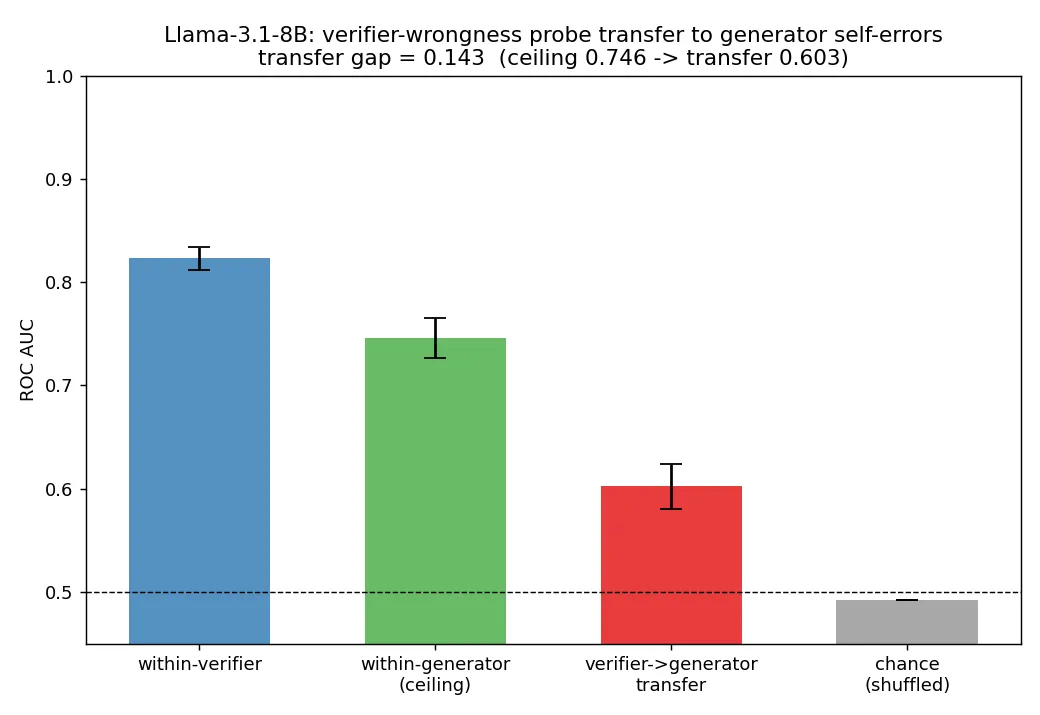
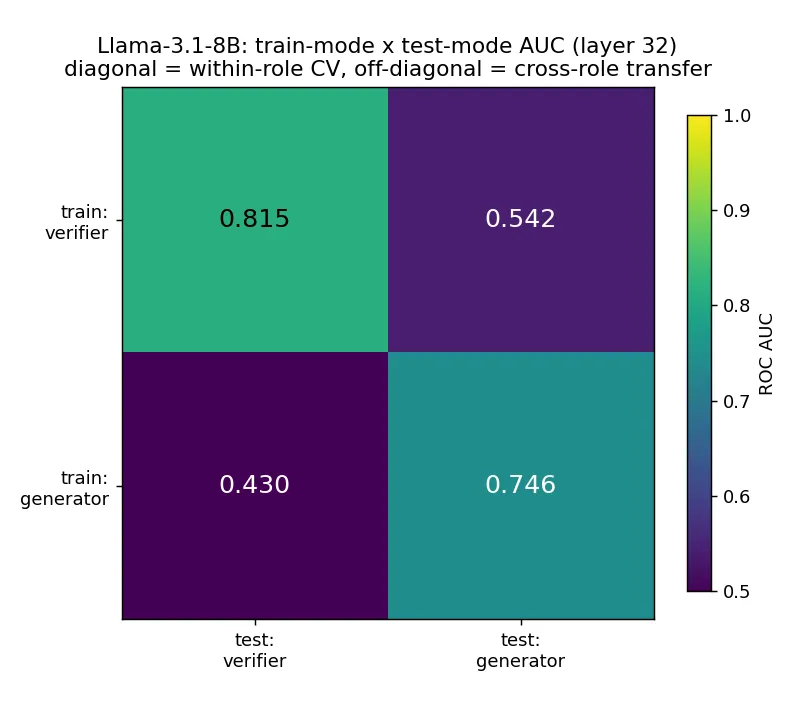
The verifier-trained direction transfers to generator self-errors only weakly. Item-disjoint verifier-to-generator transfer is 0.603 (CI 0.580 to 0.624) at its best layer and 0.542 at the layer matched to the generator ceiling, both well above the label-shuffle chance of 0.494 but far below the 0.746 ceiling. The transfer gap, ceiling minus transfer, is 0.143. Even granted its single best layer the verifier probe recovers only a fraction of what a probe trained on generation errors recovers. The reverse direction is worse: the generator-trained probe run back on verifier items scores 0.430 (CI 0.414 to 0.446), at or below chance. The within-mode chance baselines are clean (0.492 within, 0.494 transfer), so the weak transfer is a small genuine signal rather than a baseline artifact. Figure figure_transfer_matrix presents the full two by two of train mode against test mode: a bright diagonal (within-verifier 0.815, within-generator 0.746 at the common layer) over dark off-diagonal cells (0.542 and 0.430), the signature of role-bound rather than shared error awareness.
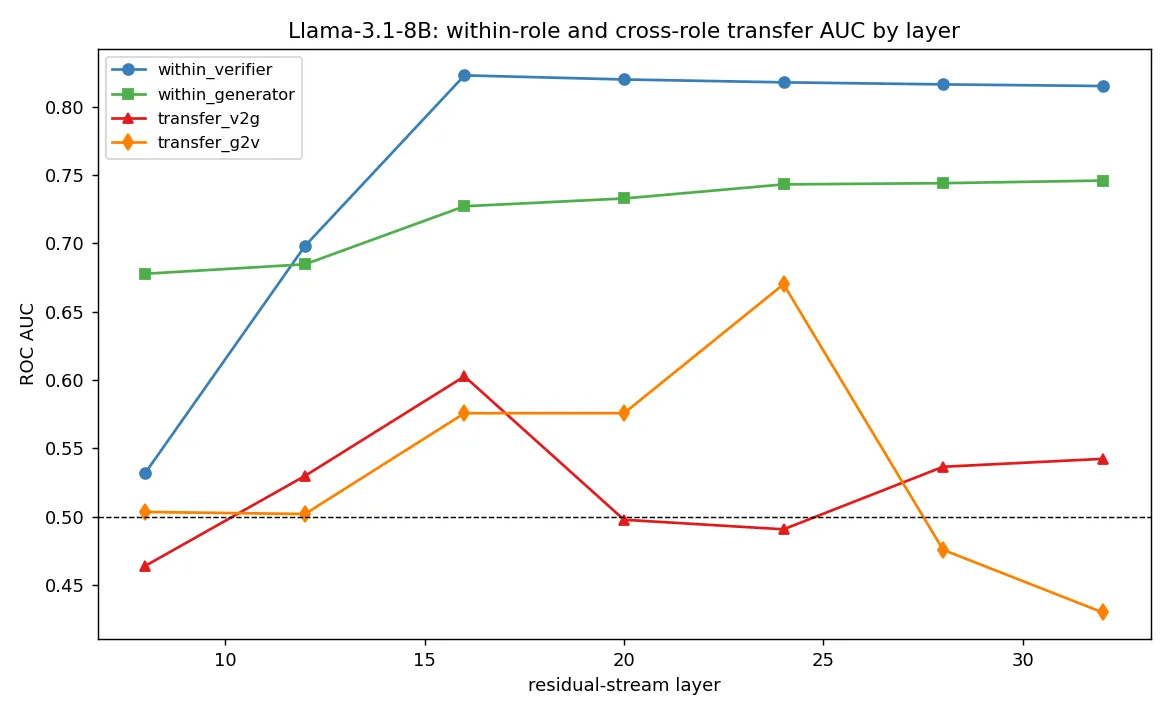
The layer sweep shows the transfer gap is not an artifact of a poorly chosen depth. The within-verifier signal rises sharply and plateaus from layer 16 onward (0.823 at 16, 0.815 at 32), the within-generator signal climbs gradually to its peak at the last layer (0.678 at 8 up to 0.746 at 32), and verifier-to-generator transfer peaks at 0.603 at layer 16 and never approaches the generator ceiling at any depth, while reverse transfer stays at chance throughout. No layer rescues transfer. Figure figure_layersweep plots all four signals against depth.
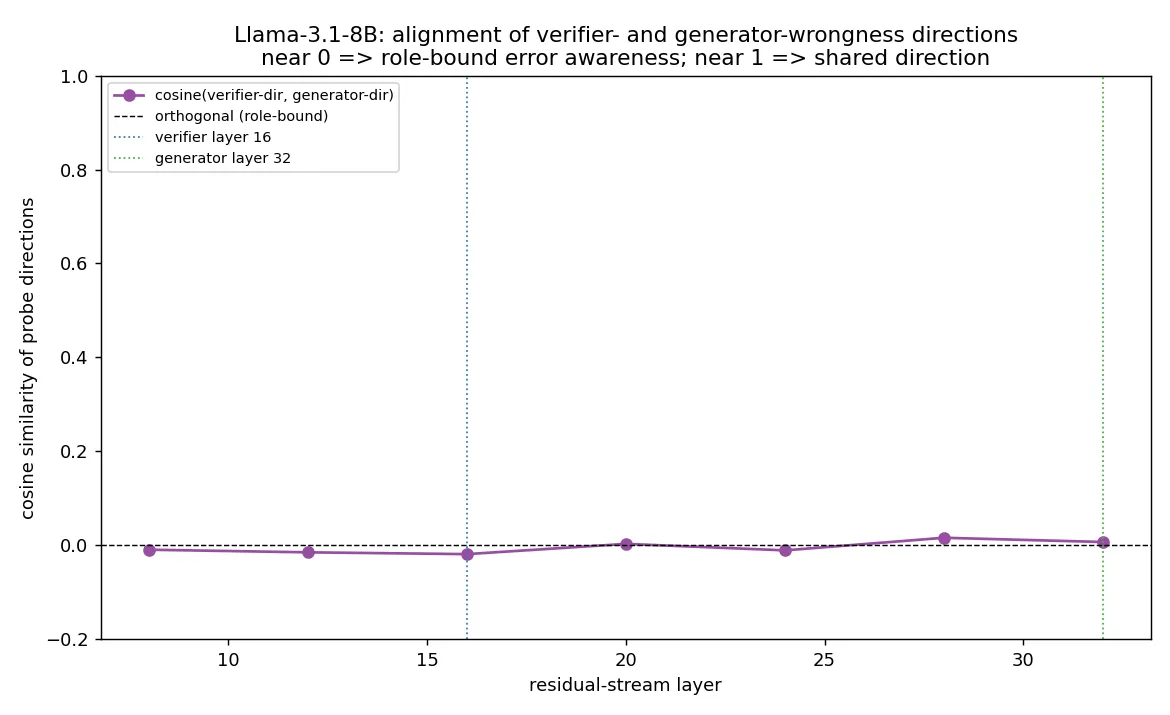
The direction-cosine test is the sharpest, and it is decisive. The verifier-wrongness and generator-wrongness probe directions are near-orthogonal at every layer, with cosine similarity ranging from -0.019 to 0.016 across the seven layers and equal to -0.019 at the verifier’s chosen layer and 0.007 at the generator’s. A shared error-awareness direction would produce a cosine near one; instead the two error representations sit in essentially unrelated directions of the residual space. Per-subject transfer is correspondingly heterogeneous and mostly weak, ranging from near or below chance on subjects such as abstract algebra (0.477) and anatomy (0.469) to modest separation on college chemistry (0.698) and formal logic (0.652), with no subject where the verifier direction reads generation errors near the within-generator ceiling. Figure figure_cosine plots the layerwise cosine.
Discussion
The picture is consistent across four independent tests. Generator self-errors are linearly decodable (ceiling 0.746), so the model does carry a readable representation of its own mistakes. A wrongness probe trained in verifier mode reads that representation only weakly (transfer 0.603, gap 0.143), the reverse direction not at all (0.430), and the two probe directions are near-orthogonal (cosine near zero) at every depth. The honest verdict is that error awareness here is largely role-bound. It is not that the verifier signal fails to transfer at all, the transfer is reliably above chance, and it is not that there is no generator signal to find, the ceiling shows there is. It is that the verifier-trained wrongness direction captures only a weak shared component of a generator self-error representation that is predominantly its own, role-specific direction.
The single most attackable reading is that the weak shared component is not shared error awareness at all but a generic difficulty or confidence signal that happens to correlate with wrongness in both modes, so that the 0.603 is a third variable rather than a transported error feature. Two features of the data push against collapsing everything to one shared axis. First, the transfer is asymmetric: verifier-to-generator (0.603) substantially exceeds generator-to-verifier (0.430). A single shared difficulty axis read by both probes would transfer roughly symmetrically; the asymmetry indicates the verifier and generator wrongness signals are not interchangeable projections of one feature. Second, the direction cosine is near zero, not merely below one. If the two probes were reading a common axis with role-specific noise on top, their weight vectors would share a component and the cosine would be appreciably positive; an essentially zero cosine at every layer says the dominant directions are unrelated. The most this licenses is that a thin, possibly difficulty-flavored component is shared while the bulk of each role’s error representation is distinct, which is exactly the role-bound reading.
For oversight the implication is concrete. A wrongness probe validated where it is easiest to validate, in verifier mode on labeled candidate answers, should not be assumed to monitor the model’s own errors as it generates (Park et al., 2024) (Pacchiardi et al., 2024). The deployment-relevant signal, whether the model is now committing a mistake, lives in a largely different direction from the one a verifier probe learns, and the gap between internal state and committed output is precisely the regime where a monitor is most needed (Turpin et al., 2023) (Burns et al., 2023). A usable generator-error monitor likely has to be trained on generator self-errors directly rather than ported from a verifier probe.
Limitations
The evidence is one model, Llama-3.1-8B-Instruct, on one multiple-choice benchmark, MMLU, with direct single-letter answering and a single family of last-token linear probes on the residual stream. Whether the role-bound pattern holds for larger models, generative or open-ended tasks, chain-of-thought traces, or nonlinear and multi-token readouts is untested, and a different readout position or a nonlinear probe could in principle recover a shared direction this design misses.
The verifier and generator labels are not identical in kind, which bounds the comparison. The verifier label is the ground-truth wrongness of a shown candidate answer, independent of the model’s verdict, whereas the generator label is whether the model’s own committed answer is wrong. We hold the verifier role constant precisely so the probe reads wrongness and not the prompt, but a verifier judging an externally supplied answer and a generator judging its own commitment may differ in ways beyond role narrowly construed, and the transfer gap folds in whatever that difference is.
Finally, the weak above-chance transfer admits more than one interpretation. We argue from the asymmetry and the near-zero cosine that it is a thin shared component atop predominantly role-specific representations rather than a single shared error axis, but the experiment does not isolate what that shared component is, and a dedicated difficulty-matched or confidence-controlled design would be needed to say whether the residual transfer is genuine cross-role error awareness or a generic correlate. The negative headline, that the verifier-trained direction is not a substitute for a generator-error monitor, does not depend on resolving this: it follows directly from the 0.143 gap, the chance-level reverse transfer, and the orthogonal directions.
Conclusion
On Llama-3.1-8B-Instruct over identical MMLU items, a linear wrongness probe trained in verifier mode barely transfers to the model’s own generation errors. Generator self-errors are linearly decodable (ceiling AUC 0.746), but the verifier-trained direction reads them at only 0.603 at its best layer (gap 0.143), reverse transfer is at chance (0.430), and the verifier-wrongness and generator-wrongness directions are near-orthogonal at every layer. Error awareness, at least as a linear last-token feature in this setting, is largely role-bound: a genuine generator self-error signal exists, the verifier probe captures only a weak shared component of it, and the two error representations are predominantly distinct. A probe validated as a verifier monitor cannot be assumed to catch a model’s own mistakes.
References
- [alain2016probes] Alain, Guillaume and Bengio, Yoshua (2016). Understanding Intermediate Layers Using Linear Classifier Probes. arXiv:1610.01644.Origin of the linear-probe methodology we use to read a wrongness direction from residual activations.
- [belinkov2022probing] Belinkov, Yonatan (2022). Probing Classifiers: Promises, Shortcomings, and Advances. arXiv:2102.12452.Survey bounding what a linear probe licenses us to claim; grounds our item-disjoint, train-mode-only protocol.
- [burns2023ccs] Burns, Collin and Ye, Haotian and Klein, Dan and Steinhardt, Jacob (2023). Discovering Latent Knowledge in Language Models Without Supervision. arXiv:2212.03827.Internal representations can encode truth even when outputs do not; the premise that a single internal direction might span modes.
- [azaria2023internal] Azaria, Amos and Mitchell, Tom (2023). The Internal State of an LLM Knows When It's Lying. arXiv:2304.13734.Closest precedent for training a probe on hidden states to detect false statements; verifier-mode probing is its judge-the-answer instance.
- [marks2024geometry] Marks, Samuel and Tegmark, Max (2024). The Geometry of Truth: Emergent Linear Structure in Large Language Model Representations of True/False Datasets. arXiv:2310.06824.Evidence that truth is linearly represented, motivating the last-token linear probe we train in each mode.
- [li2023iti] Li, Kenneth and Patel, Oam and Vi\'egas, Fernanda and Pfister, Hanspeter and Wattenberg, Martin (2023). Inference-Time Intervention: Eliciting Truthful Answers from a Language Model. arXiv:2306.03341.Truth-correlated directions are causally usable, reinforcing that the probe reads a real internal feature rather than a surface artifact.
- [zou2023repe] Zou, Andy and Phan, Long and Chen, Sarah and others (2023). Representation Engineering: A Top-Down Approach to AI Transparency. arXiv:2310.01405.Representation-reading framing for honesty; raises whether such directions are context- or role-conditioned, which our cross-mode test settles empirically.
- [chwang2024androids] CH-Wang, Sky and Van Durme, Benjamin and Eisner, Jason and Kedzie, Chris (2024). Do Androids Know They're Only Dreaming of Electric Sheep?. arXiv:2312.17249.Hallucination detection from internal states; a sibling use of probes for error awareness in generation mode.
- [orgad2024llmsknowmore] Orgad, Hadas and Toker, Michael and Gekhman, Zorik and Reichart, Roi and Szpektor, Idan and Kotek, Hadas and Belinkov, Yonatan (2024). LLMs Know More Than They Show: On the Intrinsic Representation of LLM Hallucinations. arXiv:2410.02707.Shows internal error signals are localized and task-specific and that probes generalize poorly across tasks; the strongest prior that a wrongness direction may be role-bound.
- [kadavath2022know] Kadavath, Saurav and Conerly, Tom and Askell, Amanda and others (2022). Language Models (Mostly) Know What They Know. arXiv:2207.05221.Foundational P(True) self-evaluation; the verifier mode we probe is the internal correlate of this judge-your-own-answer signal.
- [lin2022teaching] Lin, Stephanie and Hilton, Jacob and Evans, Owain (2022). Teaching Models to Express Their Uncertainty in Words. arXiv:2205.14334.Verbalized uncertainty, a behavioral baseline against which an internal cross-mode probe can be compared.
- [tian2023justask] Tian, Katherine and Mitchell, Eric and Zhou, Allan and others (2023). Just Ask for Calibration: Strategies for Eliciting Calibrated Confidence Scores from Language Models Fine-Tuned with Human Feedback. arXiv:2305.14975.Elicitation methods for confidence; the verifier judgement is a structured form of asking the model to rate its own answer.
- [xiong2023canllms] Xiong, Miao and Hu, Zhiyuan and Lu, Xinyang and others (2024). Can LLMs Express Their Uncertainty? An Empirical Evaluation of Confidence Elicitation in LLMs. arXiv:2306.13063.Systematic evaluation of verbalized confidence and its overconfidence failure modes, which an internal probe might bypass.
- [guo2017calibration] Guo, Chuan and Pleiss, Geoff and Sun, Yu and Weinberger, Kilian Q. (2017). On Calibration of Modern Neural Networks. arXiv:1706.04599.Classical calibration reference grounding the gap between a model's stated confidence and its actual correctness.
- [hendrycks2017baseline] Hendrycks, Dan and Gimpel, Kevin (2017). A Baseline for Detecting Misclassified and Out-of-Distribution Examples in Neural Networks. arXiv:1610.02136.Establishes confidence-as-detector evaluation by AUC, the metric we apply to every probe and transfer cell.
- [kuhn2023semantic] Kuhn, Lorenz and Gal, Yarin and Farquhar, Sebastian (2023). Semantic Uncertainty: Linguistic Invariances for Uncertainty Estimation in Natural Language Generation. arXiv:2302.09664.Sampling-based generation-mode uncertainty; a behavioral alternative to an internal generator-error probe.
- [cobbe2021verifiers] Cobbe, Karl and Kosaraju, Vineet and Bavarian, Mohammad and others (2021). Training Verifiers to Solve Math Word Problems. arXiv:2110.14168.Introduces the verifier-vs-generator framing operationally; we ask whether the internal correlate of judging is the same as that of generating.
- [lightman2023verify] Lightman, Hunter and Kosaraju, Vineet and Burda, Yura and others (2024). Let's Verify Step by Step. arXiv:2305.20050.Process verifiers that judge correctness; motivates why a transferable internal wrongness direction would matter for oversight.
- [saunders2022selfcritique] Saunders, William and Yeh, Catherine and Wu, Jeff and Bills, Steven and Ouyang, Long and Ward, Jonathan and Leike, Jan (2022). Self-Critiquing Models for Assisting Human Evaluators. arXiv:2206.05802.Critique (verifier) ability can exceed answer ability, the generation-evaluation gap our probe tests at the representational level.
- [madaan2023selfrefine] Madaan, Aman and Tandon, Niket and Gupta, Prakhar and others (2023). Self-Refine: Iterative Refinement with Self-Feedback. arXiv:2303.17651.A model judging then fixing its own output; assumes the verifier and generator share access to a wrongness signal, which we test directly.
- [weng2023selfverification] Weng, Yixuan and Zhu, Minjun and Xia, Fei and Li, Bin and He, Shizhu and Liu, Shengping and Sun, Bin and Liu, Kang and Zhao, Jun (2023). Large Language Models are Better Reasoners with Self-Verification. arXiv:2212.09561.Self-verification improves reasoning; presumes the model can detect its own errors, the capacity our cross-mode probe localizes or refutes.
- [huang2024selfcorrect] Huang, Jie and Chen, Xinyun and Mishra, Swaroop and Zheng, Huaixiu Steven and Yu, Adams Wei and Song, Xinying and Zhou, Denny (2024). Large Language Models Cannot Self-Correct Reasoning Yet. arXiv:2310.01798.Intrinsic self-correction often fails; a behavioral negative result our representational test gives a mechanism for if the wrongness direction is role-bound.
- [west2024genaiparadox] West, Peter and Lu, Ximing and Dziri, Nouha and others (2024). The Generative AI Paradox: What It Can Create, It May Not Understand. arXiv:2311.00059.Generation and evaluation competence dissociate behaviorally; we ask whether they also dissociate in the internal error representation.
- [stechly2023gpt4wrong] Stechly, Kaya and Marquez, Matthew and Kambhampati, Subbarao (2023). GPT-4 Doesn't Know It's Wrong: An Analysis of Iterative Prompting for Reasoning Problems. arXiv:2310.12397.Verifier-mode judgements can be unreliable; sharpens the question of whether a trained internal verifier signal is genuine and transferable.
- [kamoi2024selfcorrection] Kamoi, Ryo and Zhang, Yusen and Zhang, Nan and Han, Jiawei and Zhang, Rui (2024). When Can LLMs Actually Correct Their Own Mistakes? A Critical Survey of Self-Correction of LLMs. arXiv:2406.01297.Survey delineating when self-correction works; frames role-bound error awareness as a candidate explanation for the inconsistent results.
- [hendel2023taskvectors] Hendel, Roee and Geva, Mor and Globerson, Amir (2023). In-Context Learning Creates Task Vectors. arXiv:2310.15916.Tasks are encoded as compact internal vectors that shift with context; the mechanism by which a verifier-trained direction could be mode-specific.
- [todd2024functionvectors] Todd, Eric and Li, Millicent L. and Sharma, Arnab Sen and Mueller, Aaron and Wallace, Byron C. and Bau, David (2024). Function Vectors in Large Language Models. arXiv:2310.15213.Compact task representations that transport across prompts; the positive analog for whether a wrongness direction transports across modes.
- [turpin2023saywhat] Turpin, Miles and Michael, Julian and Perez, Ethan and Bowman, Samuel R. (2023). Language Models Don't Always Say What They Think: Unfaithful Explanations in Chain-of-Thought Prompting. arXiv:2305.04388.Stated reasoning can diverge from internal computation; supports reading error awareness from activations rather than self-report.
- [lanham2023faithfulness] Lanham, Tamera and Chen, Anna and Radhakrishnan, Ansh and others (2023). Measuring Faithfulness in Chain-of-Thought Reasoning. arXiv:2307.13702.Faithfulness of stated reasoning to internal state; the gap an internal cross-mode probe is meant to bypass.
- [sharma2023sycophancy] Sharma, Mrinank and Tong, Meg and Korbak, Tomasz and others (2023). Towards Understanding Sycophancy in Language Models. arXiv:2310.13548.Stated outputs can be driven by factors other than correctness, a confound that an internal probe trained in one mode must survive.
- [pacchiardi2024liar] Pacchiardi, Lorenzo and Chan, Alex J. and Mindermann, S\"oren and others (2024). How to Catch an AI Liar: Lie Detection in Black-Box LLMs by Asking Unrelated Questions. arXiv:2309.15840.Black-box contrast to our white-box probe; both target the gap between what a model knows and what it outputs.
- [park2024deception] Park, Peter S. and Goldstein, Simon and O'Gara, Aidan and Chen, Michael and Hendrycks, Dan (2024). AI Deception: A Survey of Examples, Risks, and Potential Solutions. arXiv:2308.14752.Frames the oversight stakes of error-awareness probes: a detector usable only in verifier mode is a weaker monitor than a role-general one.
- [hendrycks2021mmlu] Hendrycks, Dan and Burns, Collin and Basart, Steven and others (2021). Measuring Massive Multitask Language Understanding. arXiv:2009.03300.Source benchmark for the items answered in both verifier and generator mode.
- [grattafiori2024llama3] Grattafiori, Aaron and Dubey, Abhimanyu and Jauhri, Abhinav and others (2024). The Llama 3 Herd of Models. arXiv:2407.21783.Model card for Llama-3.1-8B, one of the studied instruct models.
- [qwen2024qwen25] Yang, An and Yang, Baosong and Zhang, Beichen and others (2024). Qwen2.5 Technical Report. arXiv:2412.15115.Model card for Qwen2.5-7B, one of the studied instruct models.
- [jiang2023mistral] Jiang, Albert Q. and Sablayrolles, Alexandre and Mensch, Arthur and others (2023). Mistral 7B. arXiv:2310.06825.Model card for Mistral-7B, one of the studied instruct models.