
Pre-Answer States Encode Correctness but Only Marginally Separate "Cannot Solve" from "Slipped"
≈ $153.19 compute tokens $153.19 · GPU <$0.01
Download paper (PDF, NeurIPS format)
A Selection-Corrected Error-Awareness Probe on GSM8K
Ephraiem Sarabamoun
Abstract
When a model answers a problem incorrectly, the failure can be a genuine inability to solve it or a slip in execution on a problem it can solve. We ask whether a model linearly represents which kind of failure is underway before it commits to an answer. On GSM8K with Qwen2.5-3B-Instruct, we label each greedy-wrong problem by self-consistency, drawing K=6 samples and calling the failure a slip if at least one sample is correct (capability present) and a cannot if none are (consistent incapacity), a labeling rooted in sampling consistency (Wang et al., 2022) and consistency-based reliability checks (Manakul et al., 2023). We then train a linear probe on the pre-answer hidden state, the residual stream at the last token before the answer marker, to separate slip from cannot (Marks and Tegmark, 2023), following the view that concepts are linear directions (Park et al., 2023). Two findings, one robust and one marginal. Robustly, a correct-versus-wrong probe on the pre-answer states is well above chance (AUC 0.7600, n=800), so the pre-answer hidden state plainly carries information about whether the answer will be right. The finer slip-versus-cannot separation is only marginal once we correct for layer selection: the best-layer AUC is 0.6547 (n=136), but because we select the best of five layers, the honest significance test is a selection-matched permutation null that re-selects the best layer on each shuffle, against which the observed value gives p=0.040 and sits at roughly the null’s 96th percentile, below its 97.5th percentile of 0.659. So the separation does not clear the selection-matched null’s upper bound, and a naive single-layer null overstates it. Combined with a small cannot class (37 of 136 wrong items) and a label that conflates the failure mode with problem difficulty and confidence, we report the slip-versus-cannot result as weak, selection-sensitive evidence rather than an established effect.
1. Introduction
Models carry usable internal signals about whether they are right: hidden-state probes detect statement falsehood (Azaria and Mitchell, 2023), latent correctness structure is recoverable without supervision (Burns et al., 2022), and models are partially calibrated about their own correctness (Kadavath et al., 2022). A finer question for error-aware oversight is whether the model distinguishes kinds of failure. Two error-prone situations are very different for a monitor: a slip, where the model could solve the problem but a single rollout went wrong, and an incapacity, where the model cannot solve it at all. If the pre-answer hidden state linearly encodes which is happening, a cheap probe could flag recoverable slips separately from genuine knowledge gaps. We test this directly, using self-consistency sampling to assign the labels (Wang et al., 2022), a discrete cousin of semantic-uncertainty estimation (Kuhn et al., 2023), and a linear probe on the residual stream to read them, with truthfulness-direction work as precedent that such concepts are linearly available (Li et al., 2023) and readable as activation directions (Zou et al., 2023).
2. Method
We evaluate Qwen2.5-3B-Instruct (Yang et al., 2024) on 800 GSM8K test problems (Cobbe et al., 2021), prompting for brief step-by-step reasoning (Wei et al., 2022) ending in a line ”####
3. Results
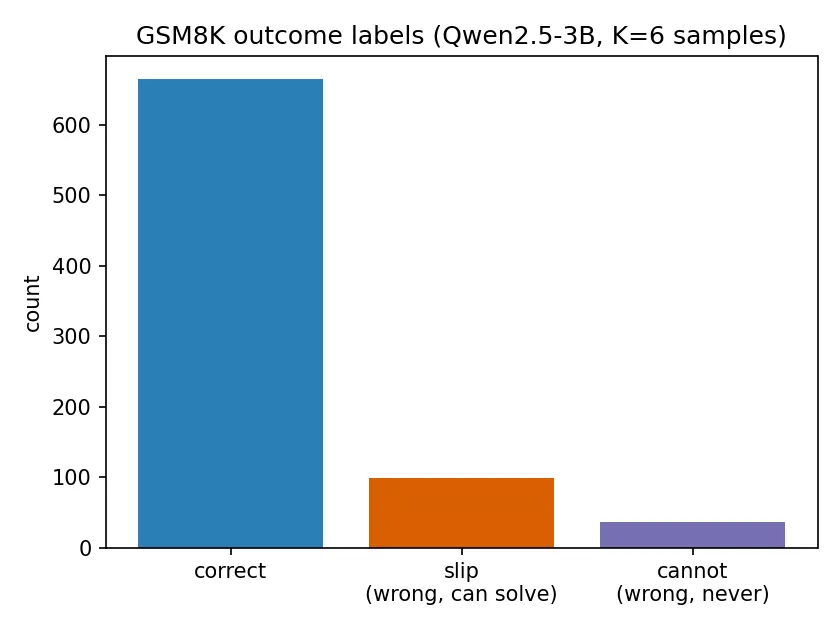
The labels split as expected for a capable model: of 800 problems the model answered 664 correctly at greedy decoding (83.0 percent), leaving 136 wrong, of which 99 are slips (some sample correct) and 37 are cannots (no sample correct in six tries). Figure 3 shows the split. The cannot class is the minority and the source of most of the statistical uncertainty.
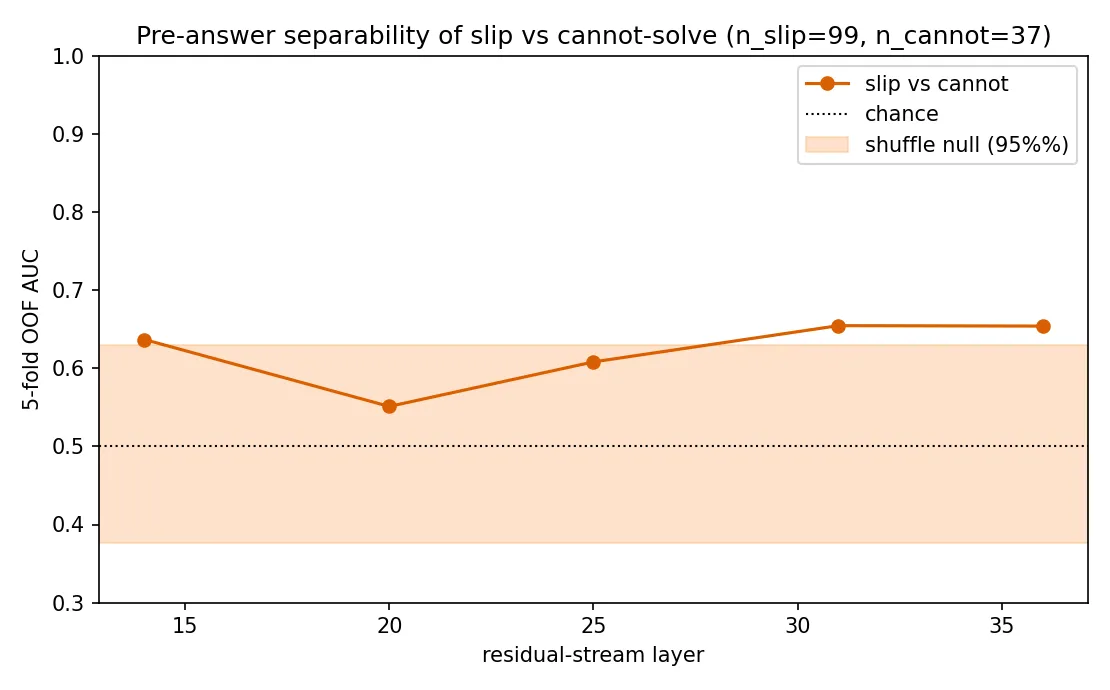
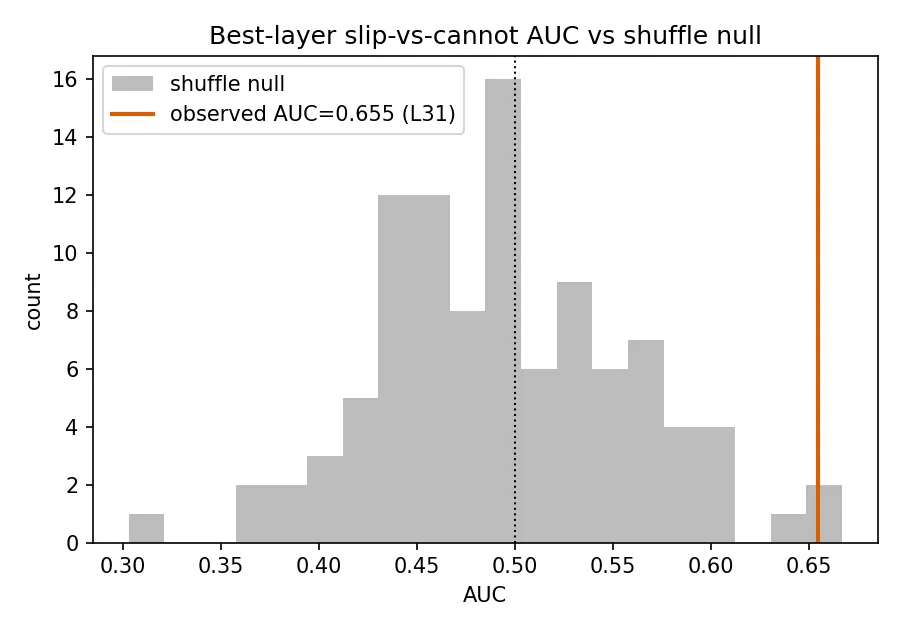
The pre-answer probe separates the two failure modes, but only marginally once layer selection is accounted for. At the best layer (31 of 36) the slip-versus-cannot AUC is 0.6547 (95 percent CI 0.5494 to 0.7547, n=136); the within-layer interval excludes 0.5, and a naive single-layer shuffle null (mean 0.4943, 95 percent interval 0.3764 to 0.6294, Figure 4) is easily cleared. But the best layer was chosen to maximize AUC over five layers, so the naive null understates the chance baseline. The honest test is a selection-matched permutation null that re-selects the best layer on every shuffle: against it the observed 0.6547 gives a permutation p of 0.040 and lands at about the 96th percentile, just below the selection-matched null’s 97.5th percentile of 0.659. The effect is therefore real at the 0.05 level but does not clear the selection-matched upper bound, and we treat it as marginal. Figure 1 shows the AUC rising into the mid-to-late layers, consistent with a signal that forms as the model works toward the answer.
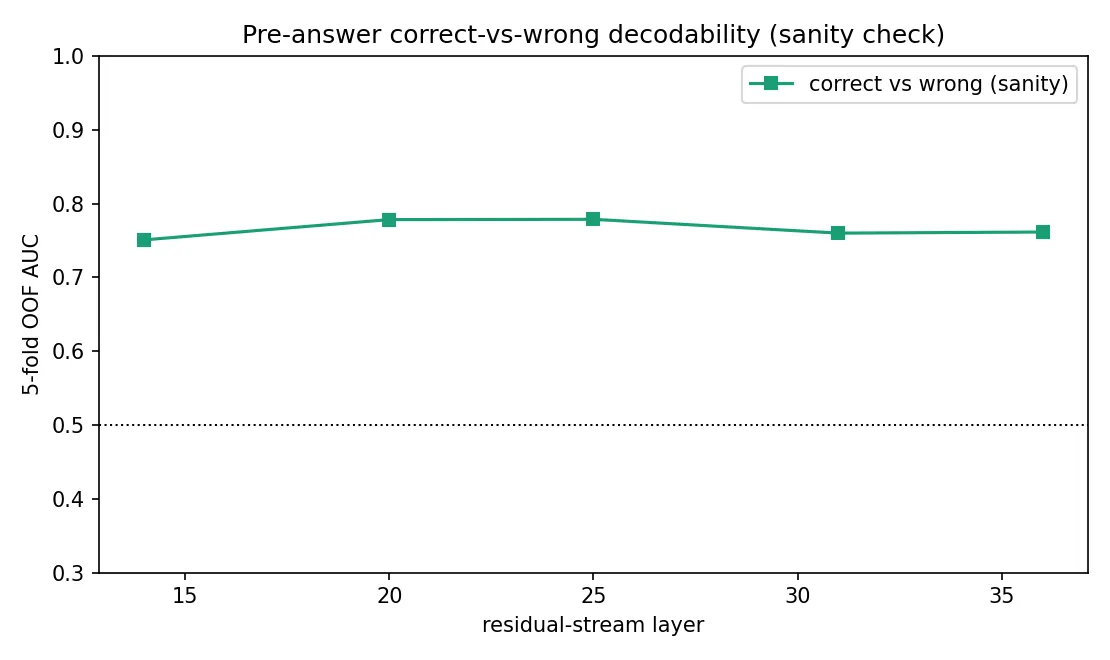
The sanity probe behaves as it must for the result to mean anything. Correct-versus-wrong is well above chance on the same pre-answer states, AUC 0.7600 (95 percent CI 0.7128 to 0.8057, n=800), shown across layers in Figure 2. So the pre-answer hidden state plainly carries information about whether the answer will be right, and the more delicate finding is that, within the wrong answers, it carries graded information about whether the model could have been right.
4. Discussion and limitations
The honest reading separates a robust finding from a marginal one. Robustly, the pre-answer hidden state encodes whether the answer will be correct (correct-versus-wrong AUC 0.76). Marginally, within the wrong answers, a linear probe separates “could have solved this but slipped” from “cannot solve this” at AUC 0.65, which is significant within the selected layer and at a selection-matched permutation p of 0.040, but does not clear the selection-matched null’s upper bound. For error-aware oversight the encouraging part is the correctness signal; the failure-mode distinction is at best weakly present here.
The limitations bound how much to make of it. First and most important, the slip-versus-cannot effect is marginal under proper selection correction: the best-of-five-layers AUC clears a naive single-layer null but only reaches the 96th percentile of a selection-matched null (p=0.040), so the separation is not robust, and the cannot class is small (37 items) with a wide interval (0.55 to 0.75). Second, and most important, the self-consistency label conflates the failure mode with problem difficulty and model confidence: a cannot is operationally a problem the model never solved in six tries, which is also what a hard or low-confidence problem looks like, so the probe may be reading a graded capability-or-difficulty signal, closely related to calibrated confidence (Kadavath et al., 2022; Guo et al., 2017; Kuhn et al., 2023), rather than a categorical slip-versus-cannot representation; we cannot separate these here and we do not claim to. Third, the cannot label is noisy at K=6, since a few more samples could reclassify a borderline cannot as a slip. Fourth, the pre-answer state is located heuristically at the last token before the answer marker, and we study one model at one size on one task. The constructive contribution is the self-consistency-labeled, pre-answer probing design and an honest, bounded positive that a higher-powered study (more cannot items, a difficulty-matched control, and a causal check) should sharpen.
5. Conclusion
We asked whether models linearly distinguish a slip from an incapacity in their pre-answer hidden states. On Qwen2.5-3B-Instruct on GSM8K the answer is: marginally. The pre-answer state robustly encodes correctness (AUC 0.76), and within wrong answers a linear probe separates slip from cannot at AUC 0.65, but that separation only reaches a selection-matched permutation p of 0.040 and does not clear the selection-matched null’s upper bound, so it is weak and selection-sensitive. It is also likely entangled with problem difficulty and confidence. We therefore report it as marginal evidence that the pre-answer state encodes a graded capability signal, and we point to a difficulty-matched, higher-powered rerun with a pre-registered layer as the way to tell a genuine failure-mode representation from a confidence gradient (Kadavath et al., 2022; Marks and Tegmark, 2023).
References
- [kadavath2022know] Kadavath, Saurav and Conerly, Tom and Askell, Amanda and Henighan, Tom and Drain, Dawn and Perez, Ethan and Schiefer, Nicholas and Hatfield-Dodds, Zac and DasSarma, Nova and others (2022). Language Models (Mostly) Know What They Know. arXiv:2207.05221.Models carry calibrated self-knowledge of whether they will be correct; the behavioral basis for expecting a pre-answer failure-mode signal.
- [burns2022ccs] Burns, Collin and Ye, Haotian and Klein, Dan and Steinhardt, Jacob (2022). Discovering Latent Knowledge in Language Models Without Supervision. arXiv:2212.03827.Latent correctness-relevant structure is linearly recoverable from activations; the premise our pre-answer probe builds on.
- [marks2023geometry] Marks, Samuel and Tegmark, Max (2023). The Geometry of Truth: Emergent Linear Structure in Large Language Model Representations of True/False Datasets. arXiv:2310.06824.Linear separability of true/false in activations; methodological template for our linear failure-mode probe.
- [azaria2023internal] Azaria, Amos and Mitchell, Tom (2023). The Internal State of an LLM Knows When It's Lying. arXiv:2304.13734.Hidden states predict statement falsehood; precedent that internal states encode error-relevant information before output.
- [li2023iti] Li, Kenneth and Patel, Oam and Vi\'egas, Fernanda and Pfister, Hanspeter and Wattenberg, Martin (2023). Inference-Time Intervention: Eliciting Truthful Answers from a Language Model. arXiv:2306.03341.Truthfulness-related directions are linear and steerable; supports reading a failure-mode direction from activations.
- [zou2023repe] Zou, Andy and Phan, Long and Chen, Sarah and Campbell, James and Guo, Phillip and Ren, Richard and Pan, Alexander and Yin, Xuwang and Mazeika, Mantas and others (2023). Representation Engineering: A Top-Down Approach to AI Transparency. arXiv:2310.01405.Reads high-level concepts as activation directions; frames our probe as reading a failure-mode concept.
- [manakul2023selfcheck] Manakul, Potsawee and Liusie, Adian and Gales, Mark JF (2023). SelfCheckGPT: Zero-Resource Black-Box Hallucination Detection for Generative Large Language Models. arXiv:2303.08896.Sampling consistency flags unreliable outputs; the behavioral signal behind our self-consistency slip/cannot labels.
- [kuhn2023semantic] Kuhn, Lorenz and Gal, Yarin and Farquhar, Sebastian (2023). Semantic Uncertainty: Linguistic Invariances for Uncertainty Estimation in Natural Language Generation. arXiv:2302.09664.Sampling-based uncertainty distinguishes confident from unreliable answers; our cannot-vs-slip label is a discrete form of this.
- [wang2022selfconsistency] Wang, Xuezhi and Wei, Jason and Schuurmans, Dale and Le, Quoc and Chi, Ed and Narang, Sharan and Chowdhery, Aakanksha and Zhou, Denny (2022). Self-Consistency Improves Chain of Thought Reasoning in Language Models. arXiv:2203.11171.Multiple samples reveal whether a model can reach the answer; the method we use to separate capability from a single slipped run.
- [cobbe2021gsm8k] Cobbe, Karl and Kosaraju, Vineet and Bavarian, Mohammad and Chen, Mark and Jun, Heewoo and Kaiser, Lukasz and Plappert, Matthias and Tworek, Jerry and Hilton, Jacob and Nakano, Reiichiro and others (2021). Training Verifiers to Solve Math Word Problems. arXiv:2110.14168.GSM8K, our task and the source of clean integer answers for automatic correctness checks.
- [wei2022cot] Wei, Jason and Wang, Xuezhi and Schuurmans, Dale and Bosma, Maarten and Ichter, Brian and Xia, Fei and Chi, Ed and Le, Quoc and Zhou, Denny (2022). Chain-of-Thought Prompting Elicits Reasoning in Large Language Models. arXiv:2201.11903.Step-by-step reasoning is where execution slips occur; the setting our pre-answer probe sits in.
- [turpin2023saywhat] Turpin, Miles and Michael, Julian and Perez, Ethan and Bowman, Samuel R (2023). Language Models Don't Always Say What They Think: Unfaithful Explanations in Chain-of-Thought Prompting. arXiv:2305.04388.Output can hide the true internal computation; motivates probing internal states rather than the stated answer.
- [lanham2023measuring] Lanham, Tamera and Chen, Anna and Radhakrishnan, Ansh and Steiner, Benoit and Denison, Carson and Hernandez, Danny and Li, Dustin and Durmus, Esin and Hubinger, Evan and Kernion, Jackson and others (2023). Measuring Faithfulness in Chain-of-Thought Reasoning. arXiv:2307.13702.Distinguishing genuine reasoning from post-hoc answers; the broader faithfulness question our failure-mode distinction touches.
- [park2023linearrep] Park, Kiho and Choe, Yo Joong and Veitch, Victor (2023). The Linear Representation Hypothesis and the Geometry of Large Language Models. arXiv:2311.03658.Formalizes concepts as linear directions; grounds the choice of a linear probe for the failure-mode distinction.
- [guo2017calibration] Guo, Chuan and Pleiss, Geoff and Sun, Yu and Weinberger, Kilian Q (2017). On Calibration of Modern Neural Networks. arXiv:1706.04599.Confidence calibration; the cannot-vs-slip distinction is closely related to whether the model is internally confident it can solve the item.
- [qwen2024report] Yang, An and Yang, Baosong and Zhang, Beichen and Hui, Binyuan and Zheng, Bo and Yu, Bowen and Li, Chengyuan and Liu, Dayiheng and Huang, Fei and Wei, Haoran and others (2024). Qwen2.5 Technical Report. arXiv:2412.15115.Model card for Qwen2.5-3B-Instruct, the model probed.