
Outcome-Only RL Did Not Reduce a Model's Causal Dependence on Its Own Chain of Thought
≈ $47.64 compute tokens $47.64 · GPU <$0.01
Download paper (PDF, NeurIPS format)
A Self-CoT Corruption-Flip Null at Small Scale
Ephraiem Sarabamoun
Abstract
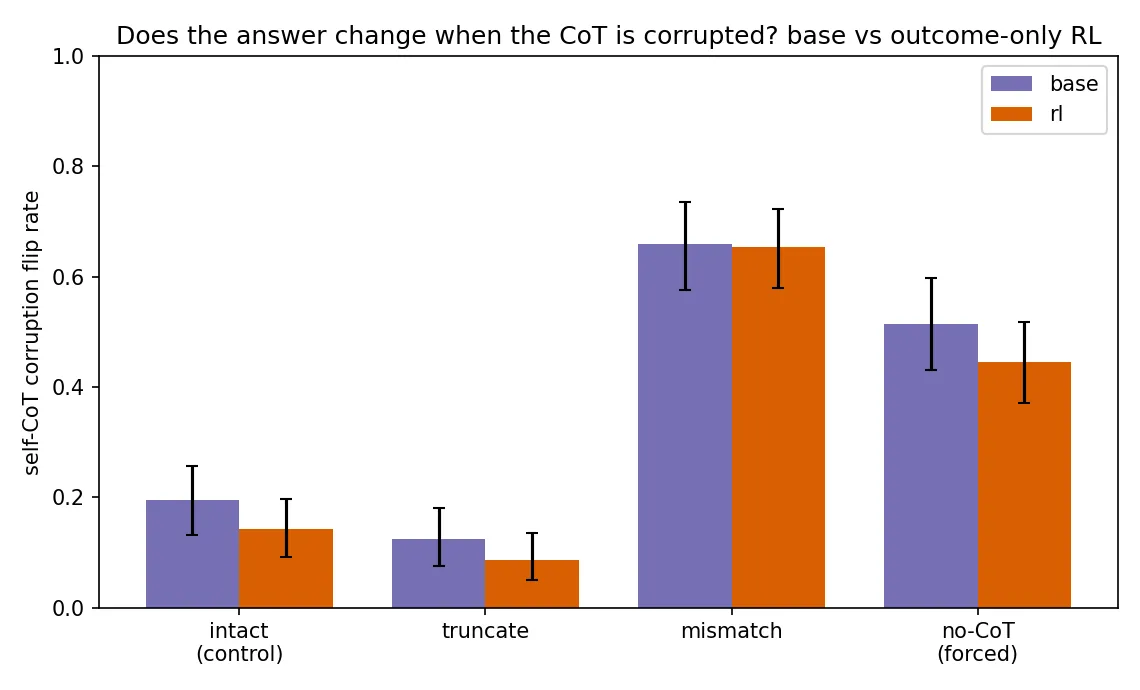
A standing worry about outcome-only reinforcement learning is that rewarding only the final answer makes the chain of thought decorative, so that the answer stops causally depending on the reasoning the model writes (Lanham et al., 2023; Turpin et al., 2023). We test this directly with a self-CoT corruption-flip protocol on Qwen2.5-1.5B-Instruct before and after outcome-only GRPO (Shao et al., 2024) on MMLU (Hendrycks et al., 2020). The model produces its own chain of thought and answer, and we then re-prompt it with that chain of thought corrupted in three ways, truncated to its first half, replaced by a different question’s chain of thought, or removed entirely with the answer forced, and measure how often the final answer changes. An intact-CoT control, re-prompting with the model’s own full chain of thought, bounds the measurement noise. The result is a null, and we are deliberately cautious about reading anything positive into it. The mismatched-CoT flip rate is statistically indistinguishable between the base model (0.6597, 95 percent CI 0.5764 to 0.7361, n=144) and the RL model (0.6543, 0.5802 to 0.7284, n=162). The no-CoT and truncate flips also differ little once their wide intervals are considered (no-CoT 0.5139 to 0.4444, truncate 0.1250 to 0.0864). We flag three confounds that keep this from being a strong null. The base and RL numbers come from different kept-item sets, so the comparison is unpaired. The truncate flip falls below the intact control (0.1250 versus 0.1944), so the intact value is not a clean lower-bound floor and the weaker-corruption comparisons are not safely interpretable as floor-relative. And accuracy is near the four-way chance level (0.3403 and 0.3272), so a high mismatch flip conflates genuine dependence on the reasoning content with generic answer instability. Above all, the RL treatment barely moved the model (accuracy 0.3403 to 0.3272), so the test had little power. We therefore report a bounded null at small scale and treat the corruption-flip-with-control protocol as a starting point that needs a paired design and an instability control before it can claim to measure causal dependence cleanly.
1. Introduction
Chain-of-thought prompting changes what models answer (Wei et al., 2022), an effect that appears even with no worked examples (Kojima et al., 2022), and a natural reading treats the chain of thought as a latent that the answer is sampled from (Wang et al., 2022). Whether the answer truly depends on that reasoning, or merely accompanies it, is the faithfulness question (Lanham et al., 2023). Faithful-by-construction reasoning, where the answer provably follows from the stated steps, has been proposed as the ideal (Lyu et al., 2023), and models are known to present explanations that are not the true cause of their answer (Turpin et al., 2023). Outcome-only reinforcement learning sharpens the worry: methods that reward only the final answer, from RLHF (Ouyang et al., 2022), including helpful-and-harmless training (Bai et al., 2022), to preference optimization (Rafailov et al., 2023) to verifiable-reward RL (Shao et al., 2024; Guo et al., 2025), optimize the answer and never the reasoning, so they could in principle drive the model toward producing a correct answer while the written chain of thought becomes post-hoc decoration. Process supervision is the proposed antidote precisely because outcome supervision leaves the steps unconstrained (Lightman et al., 2023).
We ask a specific, measurable version: does outcome-only RL reduce the final answer’s causal dependence on the model’s own chain of thought? We adapt the corrupting-CoT intervention (Lanham et al., 2023) into a before-and-after comparison on a single model and add an intact control to separate true causal dependence from measurement noise.
2. Method
We use Qwen2.5-1.5B-Instruct (Yang et al., 2024) and train it with GRPO (Shao et al., 2024) on MMLU multiple-choice questions (Hendrycks et al., 2020), with an outcome-only reward of one for the correct option letter and a small format term, never reading the chain of thought, and no answer cue in the prompt. We save a step-zero adapter, which is the base model, and a final adapter after 120 update steps. On a reserved MMLU eval slice disjoint from training, each model first produces its own chain of thought and answer by greedy decoding. We extract the answer letter and the reasoning text before the answer line, using the same parser the reward used. We then build four re-prompts that prefill the assistant turn with a version of that reasoning and read the resulting answer: intact (the model’s own full chain of thought, a control that should rarely change the answer), truncate (the first half), mismatch (a different question’s chain of thought from the same model), and no-CoT (the answer forced immediately with no reasoning). The flip rate for a condition is the fraction of items whose final answer differs from the model’s original answer; a higher flip rate means the answer is more causally dependent on the reasoning. We keep only items with a parseable answer and a non-empty chain of thought (144 for the base model, 162 for the RL model), and report percentile bootstrap 95 percent confidence intervals with 2000 resamples at seed 42. A recompute script rebuilds every number from per-example flips. Scratchpad-style reasoning that materially drives outputs (Nye et al., 2021) and verifiable-answer reward signals (Cobbe et al., 2021) are the backdrop for both the prompt format and the reward.
3. Results
The intact control was intended to bound measurement noise, and it partly does, but it does not behave as cleanly as we hoped. Re-prompting each model with its own full chain of thought changes the answer 0.1944 of the time for the base model and 0.1420 for the RL model. This is well above zero, because reconstructing the assistant turn from the extracted reasoning is a soft prefill rather than a faithful replay of the original decode. We had planned to subtract this floor from the corruption flips, but as the next paragraph shows, one corruption (truncate) flips below it, so the intact value is not a valid lower bound and we do not use it as a subtraction baseline.
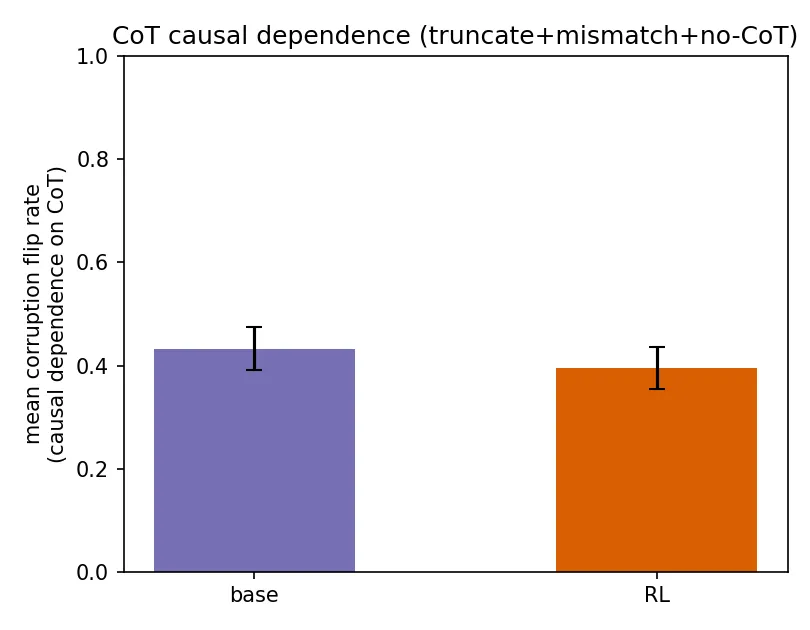
The mismatch condition, where the model must answer after reading a different question’s reasoning, gives the largest flips: 0.6597 (95 percent CI 0.5764 to 0.7361) for the base model and 0.6543 (0.5802 to 0.7284) for the RL model. The confidence intervals almost entirely overlap, so there is no detectable base-versus-RL difference. We resist the tempting reading that this 0.66 simply means the answer depends on the reasoning, because at an accuracy of 0.34, barely above the four-way chance level of 0.25, the answer is unstable to many perturbations, and swapping in a foreign chain of thought is partly just such a perturbation; the mismatch flip therefore conflates dependence on reasoning content with generic instability. The no-CoT condition flips 0.5139 for the base model and 0.4444 for the RL model, and the truncate condition flips 0.1250 and 0.0864. We had intended to read these against the intact control as a noise floor, but that logic does not hold here: the truncate flip (0.1250) is below the intact flip (0.1944), so the control is not a valid lower bound, and the floor-relative comparison is abandoned. Figure 2 shows the mean corruption flip rate at 0.4329 for the base model and 0.3951 for the RL model, a small unpaired difference we do not interpret as a real reduction.
The most important context for the null is that the RL treatment barely changed the model. Own-CoT MMLU accuracy is 0.3403 for the base model and 0.3272 for the RL model, a difference within noise and in the wrong direction for a successful accuracy-improving RL run. Figure 3 shows this. One hundred twenty GRPO steps on a 1.5 billion parameter model on hard MMLU subjects produced almost no behavioral change, so the experiment had little opportunity to observe a change in chain-of-thought reliance even if outcome-only RL induces one at scale.
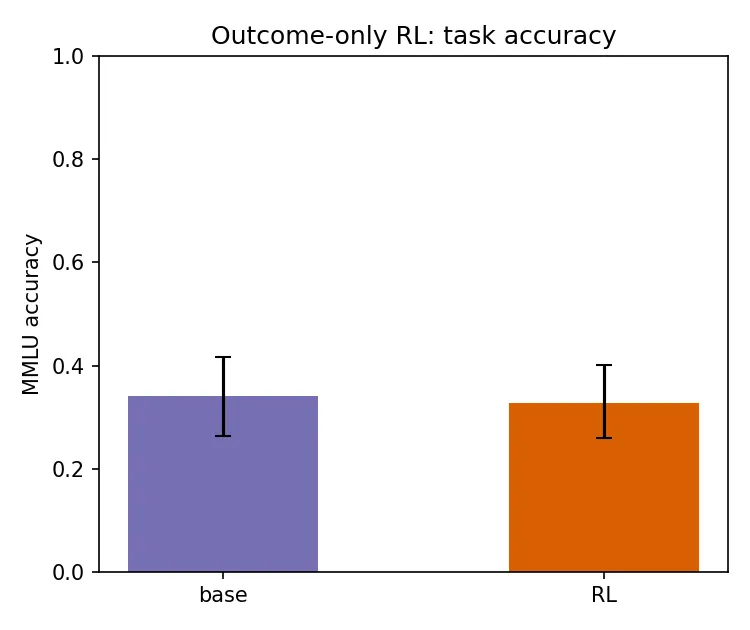
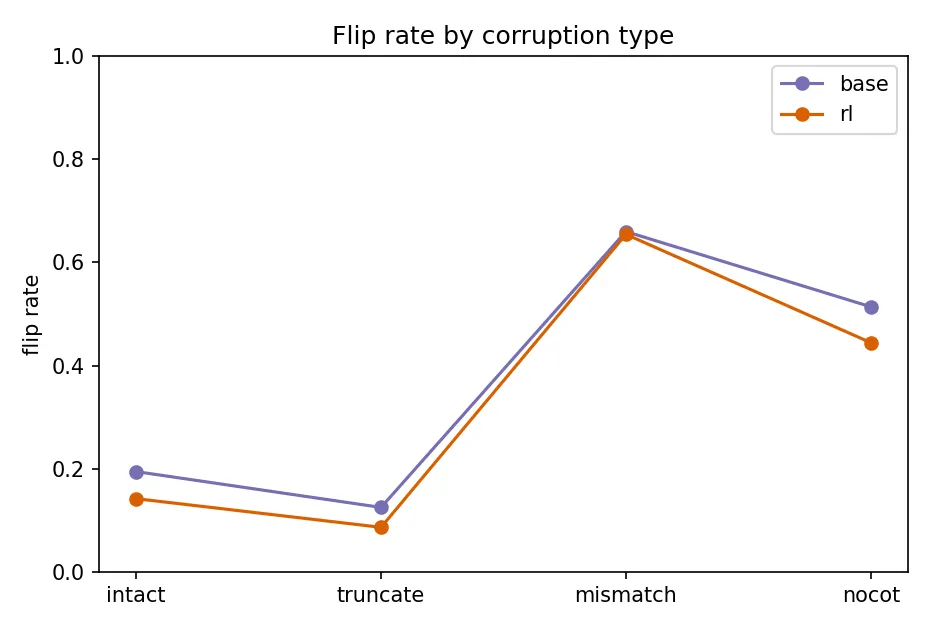
Figure 4 plots all four conditions for both models and makes the shared structure visible: the corruption severity ordering is the same for base and RL, and the two curves run close together throughout.
4. Discussion and limitations
The honest reading is a bounded, confounded null at small scale, and we list the confounds plainly because they are severe enough that we make no positive methodological claim. First and most important, the RL treatment was weak: 120 GRPO steps on a 1.5 billion parameter model did not move accuracy, so the policy barely changed and the test had little power to detect a change in reliance. A run that demonstrably reshapes behavior, or a larger model in the regime where outcome-only RL is known to transform reasoning (Guo et al., 2025), is the higher-power setting. Second, the comparison is unpaired: each model is scored on its own kept-item set (144 versus 162), because which items yield a parseable answer and a non-empty chain of thought differs between the two policies, so a paired reanalysis on the item intersection is needed before any base-versus-RL difference can be trusted. Third, the intact control does not function as a clean floor: the truncate flip falls below it, which means the soft-prefill reconstruction adds idiosyncratic noise and the floor-subtraction logic we initially planned is invalid. Fourth, base accuracy is near the four-way chance level (0.34), so the answer is intrinsically unstable and a high mismatch flip cannot be cleanly attributed to dependence on reasoning content rather than to generic instability; a within-model regenerate-from-scratch instability baseline is the missing control. Fifth, MMLU multiple choice with a small model yields short, sometimes shallow chains of thought, and we measured one model family at one size with one reward. Taken together these mean the protocol, as run here, does not yet cleanly measure causal dependence; the constructive contribution is a concrete specification of the paired design and instability control a higher-power rerun would need.
5. Conclusion
We asked whether outcome-only reinforcement learning reduces a model’s causal dependence on its own chain of thought, measured by how often corrupting that chain of thought flips the final answer. On Qwen2.5-1.5B-Instruct before and after 120 steps of outcome-only GRPO, we found no detectable difference: the mismatched-CoT flip rate is statistically identical across base and RL at about two thirds. We do not claim this as a clean result. The RL treatment barely changed the model, the comparison is unpaired, the intact control fails its own monotonicity check, and near-chance accuracy confounds the flip rate with generic instability, so this is a bounded and confounded null rather than a refutation of the broader concern (Lanham et al., 2023). The honest takeaway is a worked specification of what a credible test needs, a treatment that visibly reshapes the policy, a paired item set, and a regenerate-from-scratch instability control, which we set out for a higher-power rerun (Lightman et al., 2023).
References
- [lanham2023measuring] Lanham, Tamera and Chen, Anna and Radhakrishnan, Ansh and Steiner, Benoit and Denison, Carson and Hernandez, Danny and Li, Dustin and Durmus, Esin and Hubinger, Evan and Kernion, Jackson and others (2023). Measuring Faithfulness in Chain-of-Thought Reasoning. arXiv:2307.13702.Introduces corrupting / truncating the CoT to test whether the answer causally depends on it; our self-CoT corruption-flip protocol is a direct adaptation.
- [turpin2023saywhat] Turpin, Miles and Michael, Julian and Perez, Ethan and Bowman, Samuel R (2023). Language Models Don't Always Say What They Think: Unfaithful Explanations in Chain-of-Thought Prompting. arXiv:2305.04388.Shows stated reasoning can diverge from the true cause of the answer; the unfaithfulness our intervention tries to detect after RL.
- [shao2024deepseekmath] Shao, Zhihong and Wang, Peiyi and Zhu, Qihao and Xu, Runxin and Song, Junxiao and Bi, Xiao and Zhang, Haowei and Zhang, Mingchuan and Li, YK and Wu, Y and others (2024). DeepSeekMath: Pushing the Limits of Mathematical Reasoning in Open Language Models. arXiv:2402.03300.Introduces GRPO, the outcome-only RL algorithm we use; the training method whose effect on CoT reliance we probe.
- [guo2025deepseekr1] Guo, Daya and Yang, Dejian and Zhang, Haowei and Song, Junxiao and Zhang, Ruoyu and Xu, Runxin and Zhu, Qihao and Ma, Shirong and Wang, Peiyi and Bi, Xiao and others (2025). DeepSeek-R1: Incentivizing Reasoning Capability in LLMs via Reinforcement Learning. arXiv:2501.12948.Large-scale outcome-only RL that reshapes chains of thought; the regime our small-scale study is a controlled proxy for.
- [ouyang2022instructgpt] Ouyang, Long and Wu, Jeffrey and Jiang, Xu and Almeida, Diogo and Wainwright, Carroll and Mishkin, Pamela and Zhang, Chong and Agarwal, Sandhini and Slama, Katarina and Ray, Alex and others (2022). Training language models to follow instructions with human feedback. arXiv:2203.02155.The canonical RLHF recipe; outcome-only reward at scale, the family of methods our concern is about.
- [bai2022hh] Bai, Yuntao and Jones, Andy and Ndousse, Kamal and Askell, Amanda and Chen, Anna and DasSarma, Nova and Drain, Dawn and Fort, Stanislav and Ganguli, Deep and Henighan, Tom and others (2022). Training a Helpful and Harmless Assistant with Reinforcement Learning from Human Feedback. arXiv:2204.05862.Establishes RLHF as standard post-training; context for why outcome-reward effects on reasoning matter.
- [rafailov2023dpo] Rafailov, Rafael and Sharma, Archit and Mitchell, Eric and Ermon, Stefano and Manning, Christopher D and Finn, Chelsea (2023). Direct Preference Optimization: Your Language Model is Secretly a Reward Model. arXiv:2305.18290.A widely used outcome-level preference optimizer; part of the post-training family whose effect on CoT we test.
- [wei2022cot] Wei, Jason and Wang, Xuezhi and Schuurmans, Dale and Bosma, Maarten and Ichter, Brian and Xia, Fei and Chi, Ed and Le, Quoc and Zhou, Denny (2022). Chain-of-Thought Prompting Elicits Reasoning in Large Language Models. arXiv:2201.11903.Defines chain-of-thought reasoning; the object whose causal role we measure.
- [wang2022selfconsistency] Wang, Xuezhi and Wei, Jason and Schuurmans, Dale and Le, Quoc and Chi, Ed and Narang, Sharan and Chowdhery, Aakanksha and Zhou, Denny (2022). Self-Consistency Improves Chain of Thought Reasoning in Language Models. arXiv:2203.11171.Treats the CoT as a sampled latent that determines the answer; motivates measuring how much the answer moves when the CoT changes.
- [lightman2023letsverify] Lightman, Hunter and Kosaraju, Vineet and Burda, Yura and Edwards, Harri and Baker, Bowen and Lee, Teddy and Leike, Jan and Schulman, John and Sutskever, Ilya and Cobbe, Karl (2023). Let's Verify Step by Step. arXiv:2305.20050.Process vs outcome supervision; the contrast that makes the worry about outcome-only reward concrete.
- [lyu2023faithfulcot] Lyu, Qing and Havaldar, Shreya and Stein, Adam and Zhang, Li and Rao, Delip and Wong, Eric and Apidianaki, Marianna and Callison-Burch, Chris (2023). Faithful Chain-of-Thought Reasoning. arXiv:2301.13379.Proposes reasoning whose answer is guaranteed to follow from the stated steps; the faithfulness ideal our intervention checks against.
- [nye2021scratchpads] Nye, Maxwell and Andreassen, Anders Johan and Gur-Ari, Guy and Michalewski, Henryk and Austin, Jacob and Bieber, David and Dohan, David and Lewkowycz, Aitor and Bosma, Maarten and Luan, David and others (2021). Show Your Work: Scratchpads for Intermediate Computation with Language Models. arXiv:2112.00114.Early scratchpad reasoning that materially changes outputs; a baseline for CoT being load-bearing rather than decorative.
- [hendrycks2021mmlu] Hendrycks, Dan and Burns, Collin and Basart, Steven and Zou, Andy and Mazeika, Mantas and Song, Dawn and Steinhardt, Jacob (2020). Measuring Massive Multitask Language Understanding. arXiv:2009.03300.The MMLU benchmark we train and evaluate on.
- [qwen2024report] Yang, An and Yang, Baosong and Zhang, Beichen and Hui, Binyuan and Zheng, Bo and Yu, Bowen and Li, Chengyuan and Liu, Dayiheng and Huang, Fei and Wei, Haoran and others (2024). Qwen2.5 Technical Report. arXiv:2412.15115.Model card for Qwen2.5-1.5B-Instruct, the base model we RL-tune and probe.
- [cobbe2021gsm8k] Cobbe, Karl and Kosaraju, Vineet and Bavarian, Mohammad and Chen, Mark and Jun, Heewoo and Kaiser, Lukasz and Plappert, Matthias and Tworek, Jerry and Hilton, Jacob and Nakano, Reiichiro and others (2021). Training Verifiers to Solve Math Word Problems. arXiv:2110.14168.Verifiable-answer reasoning that grounds outcome-only reward; the reward-signal style our GRPO uses.
- [kojima2022zeroshot] Kojima, Takeshi and Gu, Shixiang Shane and Reid, Machel and Matsuo, Yutaka and Iwasawa, Yusuke (2022). Large Language Models are Zero-Shot Reasoners. arXiv:2205.11916.Shows a simple prompt elicits multi-step reasoning that changes answers; supports treating the CoT as potentially load-bearing for the final answer.