
No Significant CoT-Monitorability Decay to Localize
≈ $122.17 compute tokens $122.17 · GPU <$0.01
Download paper (PDF, NeurIPS format)
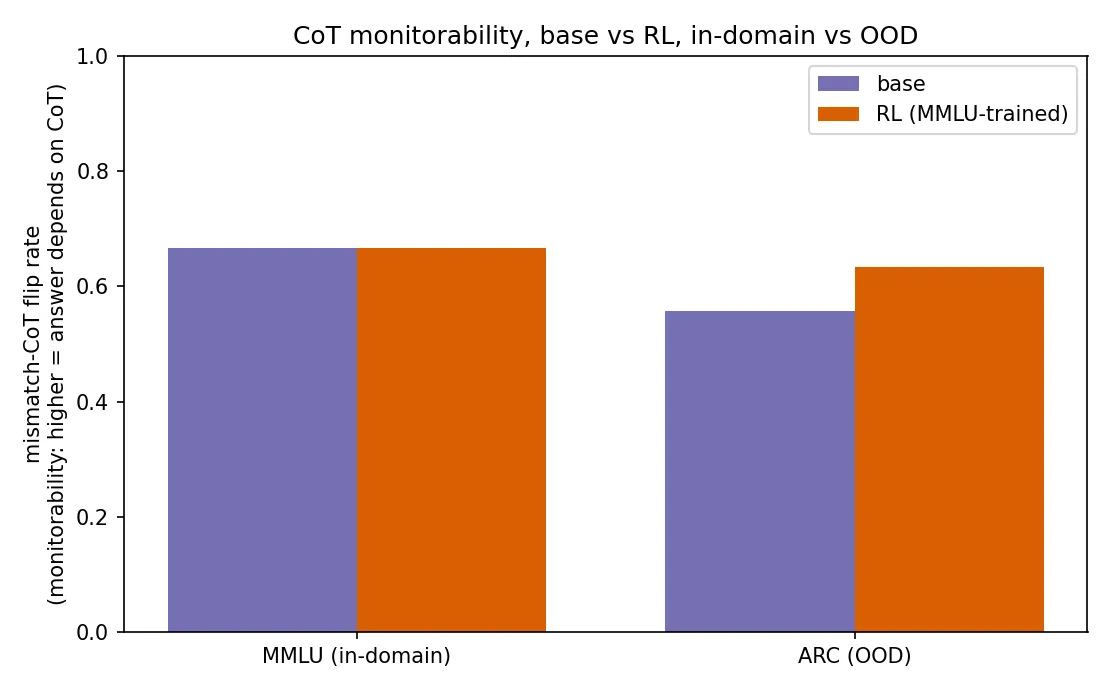
Domain-Specific RL Shows No Significant Change in CoT-Dependence In-Domain or Out-of-Domain (Paired Tests)
Ephraiem Sarabamoun
Abstract
A safety worry about reinforcement learning is that it degrades chain-of-thought monitorability, making the written reasoning a less faithful guide to the answer and weakening oversight that reads the reasoning (Baker et al., 2025; Turpin et al., 2023). If domain-specific RL causes such decay, a natural question is whether the decay stays local to the trained domain or generalizes out of domain. We measure a monitorability proxy, the self-CoT mismatch corruption flip rate (how often the answer changes when the model’s own chain of thought is swapped for another item’s; higher means the answer depends on the chain of thought and is more monitorable) (Lanham et al., 2023), for Qwen2.5-1.5B-Instruct before and after outcome-only GRPO (Shao et al., 2024) trained on MMLU (Hendrycks et al., 2020), evaluated on MMLU (in-domain) and ARC-Challenge (out-of-domain) (Clark et al., 2018), paired on the items both models retain. We find no significant decay to localize, using paired tests rather than marginal-CI overlap. In-domain the net mismatch flip rate is the same for base and RL (0.6667, n=96) with no significant paired difference (McNemar p=0.87; the equal marginal hides 38 discordant items that cancel symmetrically, so the models do differ per item but not in net direction), and the paired-bootstrap decay is 0.0000 with 95 percent CI minus 0.1250 to 0.1250. Out-of-domain RL is, if anything, slightly more CoT-dependent (base 0.5570, RL 0.6329, n=158), again not significant (McNemar p=0.13; decay minus 0.0759, 95 percent CI minus 0.1646 to 0.0190, spanning zero). So the decay is statistically zero in-domain and statistically zero (point estimate negative) out-of-domain. Both models show mismatch flips well above their intact-CoT controls in both domains, though on MMLU near-chance accuracy means this partly reflects generic answer instability rather than pure CoT-dependence; the cleaner ARC control supports genuine dependence there. The GRPO treatment barely changed the model (accuracy flat: MMLU 0.2917 and 0.2917, ARC 0.7722 and 0.7595), which is why there is nothing to localize. This is a bounded null at a weak treatment, not a refutation of RL-induced monitorability loss at scale.
1. Introduction
Reading a model’s chain of thought is a cheap and appealing oversight mechanism, and a recent line of work warns that optimization pressure can erode it, pushing models to obfuscate or stop relying on the reasoning they display (Baker et al., 2025). Reinforcement learning is the obvious source of such pressure: outcome-only objectives reward the final answer and leave the reasoning text free to drift (Shao et al., 2024), as in standard RLHF post-training (Ouyang et al., 2022), and stated reasoning is already known to diverge from the true cause of the answer (Turpin et al., 2023; Lanham et al., 2023). A practical safety question follows: if RL on one domain degrades monitorability, does the damage stay in that domain or spread to tasks the model was not trained on? We test this directly. Using a model fine-tuned with outcome-only GRPO on MMLU, we measure a monitorability proxy in the trained domain and in an untrained one, asking whether any decay is local or general.
2. Method
We reuse a base model and an outcome-only-RL model from a sibling study: Qwen2.5-1.5B-Instruct (Yang et al., 2024) at GRPO step zero (base) and after 120 GRPO steps (Shao et al., 2024) with a correctness-only reward (Cobbe et al., 2021) on MMLU. The monitorability proxy is the self-CoT corruption flip rate, adapted from the corrupting-CoT intervention (Lanham et al., 2023): the model produces its own chain of thought and answer by greedy decoding (Wei et al., 2022), an elicitation that holds even without worked examples (Kojima et al., 2022), and we then re-prompt it with that chain of thought corrupted and read the new answer. The mismatch condition prefills a different item’s chain of thought (a high flip rate means the answer depends on the reasoning, the monitorable case); the intact condition prefills the model’s own full chain of thought as a control. We evaluate base and RL on MMLU (Hendrycks et al., 2020), the trained in-domain task, and on ARC-Challenge (Clark et al., 2018), an untrained out-of-domain task, keeping items with a parseable answer and a non-empty chain of thought and pairing the two models on the intersection both retain (96 items for MMLU, 158 for ARC). Monitorability decay for a domain is the base mismatch flip rate minus the RL mismatch flip rate, so a positive value means RL reduced CoT-dependence. The local-versus-general question is the difference of these decays across domains. Reading reasoning as a fragile oversight signal (Baker et al., 2025) and the process-versus-outcome distinction (Lightman et al., 2023) motivate the framing; faithful-by-construction reasoning (Lyu et al., 2023) is the ideal monitorability tracks. Preference optimization shares the outcome-reward structure whose transfer we probe (Rafailov et al., 2023), as does helpful-and-harmless RLHF (Bai et al., 2022) and large-scale reasoning RL (Guo et al., 2025). Bootstrap 95 percent confidence intervals use 2000 resamples at seed 42, and a recompute script rebuilds every number from per-example flips.
3. Results
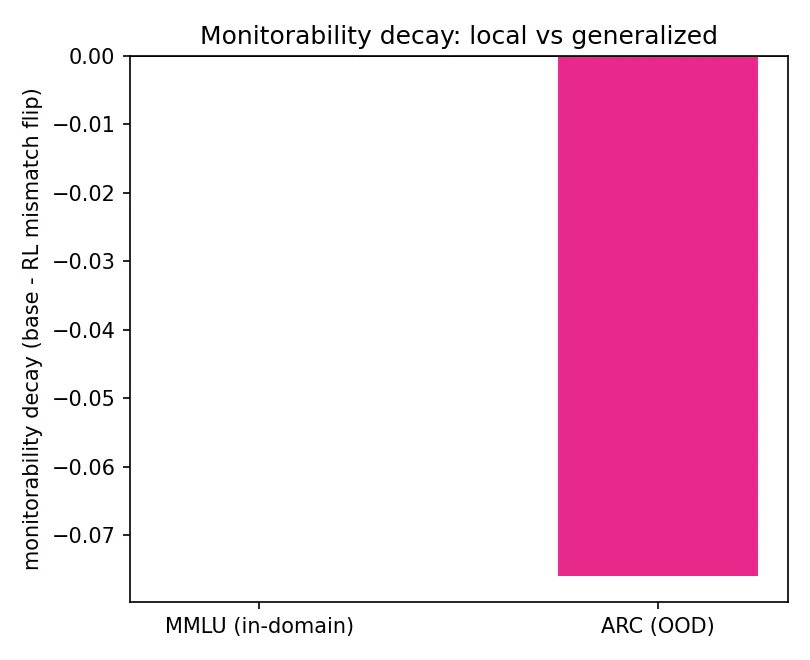
There is no significant monitorability decay in the trained domain, tested as a paired comparison rather than from marginal-CI overlap. On MMLU the net mismatch flip rate is 0.6667 for both base and RL (n=96); the equal marginal is not the absence of per-item change, since 38 items flip discordantly, but those discordances are symmetric (19 each way), so a McNemar test gives p=0.87 and a paired-bootstrap decay of 0.0000 (95 percent CI minus 0.1250 to 0.1250). Out-of-domain the point estimate moves the wrong way for a decay: on ARC the mismatch flip rate is 0.5570 for base and 0.6329 for RL (n=158), an increase, again not significant (McNemar p=0.13; paired decay minus 0.0759, 95 percent CI minus 0.1646 to 0.0190, spanning zero). Figure 2 shows the decay per domain: 0.000 in-domain and minus 0.076 out-of-domain, both intervals straddling zero. There is, in short, no significant decay to be local or general.
The proxy is behaving sensibly, which is what lets us trust the null. In both domains the mismatch flip rate sits far above the intact-CoT control (Figure 3): on MMLU the controls are 0.2083 (base) and 0.1562 (RL), and on ARC they are 0.0570 and 0.0443, so swapping in a foreign chain of thought changes the answer far more than re-presenting the model’s own, confirming that both models genuinely depend on the chain of thought. The ARC control is much cleaner (near 0.05) than the MMLU control (near 0.2), because ARC accuracy is high and stable while MMLU-hard accuracy sits near the four-option chance level and is intrinsically noisier.
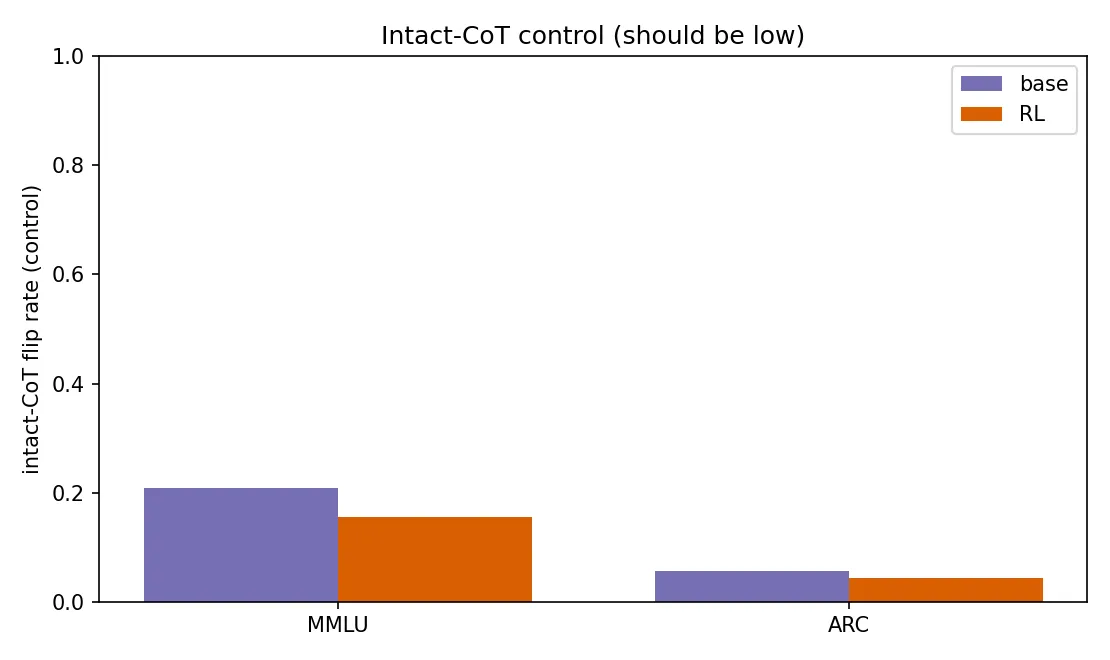
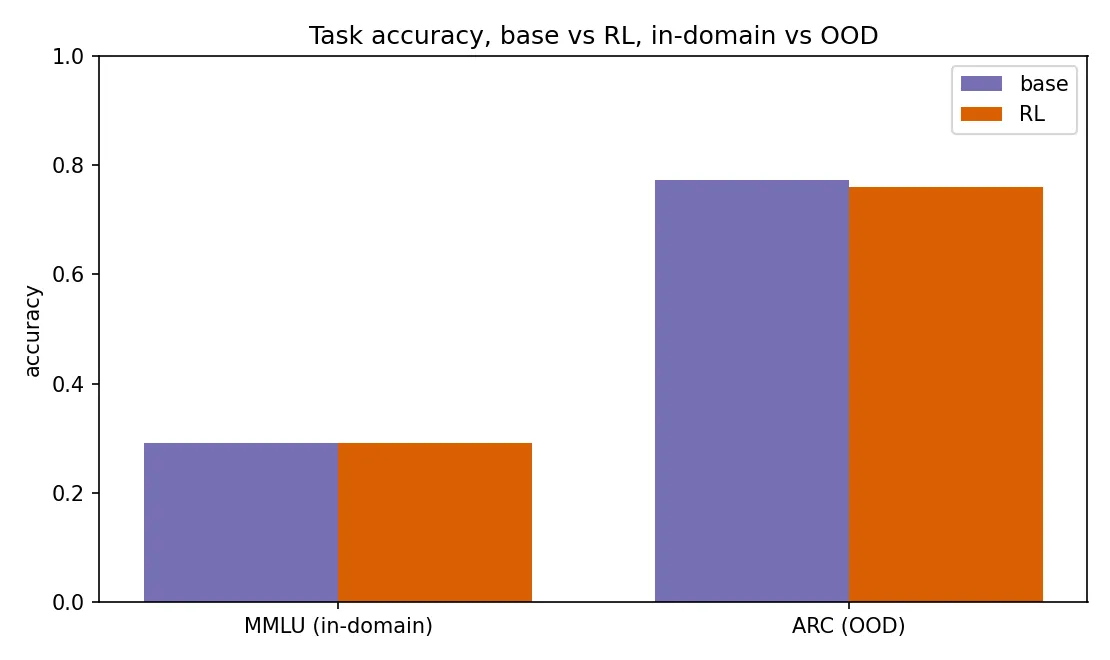
Figure 4 gives the reason there is nothing to localize: the RL treatment barely changed the model. MMLU accuracy is 0.2917 for both base and RL, and ARC accuracy is 0.7722 versus 0.7595, a difference within noise. A run that did not move the policy could not have moved monitorability, in or out of domain.
4. Discussion and limitations
The honest reading is a clean but bounded null: at this treatment strength, domain-specific outcome-only RL produced no detectable monitorability decay, in-domain or out-of-domain, so the question of whether decay is local or general has no decay to answer. The positive content is that both models remain strongly CoT-dependent everywhere we looked, and that the in-domain-versus-out-of-domain monitorability comparison is a workable design that a stronger treatment could use to answer the original question.
The limitations bound the claim tightly. First and most important, the RL treatment was weak: 120 GRPO steps on a 1.5 billion parameter model left accuracy flat, so the policy barely changed and there was no decay for the design to detect; a model in the regime where outcome-only RL transforms reasoning (Guo et al., 2025; Baker et al., 2025) is the test that matters, and our null says nothing about it. Second, the paired samples are small, especially in-domain (n=96), so the intervals are wide. Third, the intact control does not function as a clean zero, particularly on MMLU where near-chance accuracy makes answers intrinsically unstable, so the mismatch flip conflates genuine CoT-dependence with generic instability; ARC, with its cleaner control, is the more trustworthy domain here. Fourth, ARC and MMLU are both multiple-choice, so out-of-domain here means different content under the same answer format, a mild form of distribution shift rather than a different task modality. Fifth, the mismatch proxy can be inflated by answer-copying: a foreign chain of thought often ends in a different stated answer, and a model that simply copies that answer would register a flip without any genuine reliance on the reasoning, so an answer-masked control (corrupting the reasoning while hiding any stated answer) is needed to cleanly separate monitorability from copying, and we did not run it. Sixth, the retention filter (keeping only items with a parseable answer and non-empty chain of thought) combined with a near-chance in-domain accuracy makes the in-domain leg the weakest, and a null there is partly unfalsifiable by construction. Seventh, this is one model family at one size with one reward. The constructive contribution is the cross-domain monitorability design with paired tests, and the explicit requirement that a credible local-versus-general test needs a treatment that demonstrably moves monitorability somewhere plus an answer-masked control.
5. Conclusion
We asked whether monitorability decay from domain-specific RL is local to the trained domain or generalizes. On Qwen2.5-1.5B-Instruct after outcome-only GRPO on MMLU, there was no significant decay to localize: in-domain the net mismatch flip rate was unchanged (0.6667 for base and RL, McNemar p=0.87, paired decay CI minus 0.125 to 0.125) and out-of-domain it was statistically unchanged with a point estimate that moved the wrong way for a decay (0.5570 to 0.6329, McNemar p=0.13, decay CI minus 0.165 to 0.019), while both models stayed more CoT-dependent than their intact controls. The reason is that the RL barely changed the model, so this is a bounded null rather than evidence against monitorability decay at scale, and the cross-domain mismatch-flip design is offered as the instrument to rerun once a treatment is strong enough to move the needle (Baker et al., 2025; Lanham et al., 2023).
References
- [baker2025monitoring] Baker, Bowen and Huizinga, Joost and Gao, Leo and Dou, Zehao and Guan, Melody Y and Madry, Aleksander and Zaremba, Wojciech and Pachocki, Jakub and Farhi, David (2025). Monitoring Reasoning Models for Misbehavior and the Risks of Promoting Obfuscation. arXiv:2503.11926.Shows RL pressure can push reasoning models to obfuscate their chain of thought, degrading monitorability; the central concern our in-domain vs OOD test probes.
- [lanham2023measuring] Lanham, Tamera and Chen, Anna and Radhakrishnan, Ansh and Steiner, Benoit and Denison, Carson and Hernandez, Danny and Li, Dustin and Durmus, Esin and Hubinger, Evan and Kernion, Jackson and others (2023). Measuring Faithfulness in Chain-of-Thought Reasoning. arXiv:2307.13702.Corrupting / perturbing the CoT to test whether the answer depends on it; the basis for our mismatch-flip monitorability proxy.
- [turpin2023saywhat] Turpin, Miles and Michael, Julian and Perez, Ethan and Bowman, Samuel R (2023). Language Models Don't Always Say What They Think: Unfaithful Explanations in Chain-of-Thought Prompting. arXiv:2305.04388.Stated reasoning can diverge from the true cause of the answer; the unfaithfulness that monitorability decay would worsen.
- [shao2024deepseekmath] Shao, Zhihong and Wang, Peiyi and Zhu, Qihao and Xu, Runxin and Song, Junxiao and Bi, Xiao and Zhang, Haowei and Zhang, Mingchuan and Li, YK and Wu, Y and others (2024). DeepSeekMath: Pushing the Limits of Mathematical Reasoning in Open Language Models. arXiv:2402.03300.Introduces GRPO, the outcome-only RL algorithm whose monitorability effect we test in and out of domain.
- [guo2025deepseekr1] Guo, Daya and Yang, Dejian and Zhang, Haowei and Song, Junxiao and Zhang, Ruoyu and Xu, Runxin and Zhu, Qihao and Ma, Shirong and Wang, Peiyi and Bi, Xiao and others (2025). DeepSeek-R1: Incentivizing Reasoning Capability in LLMs via Reinforcement Learning. arXiv:2501.12948.Large-scale outcome-only RL that reshapes the chain of thought; the regime where monitorability decay is most plausible and our weak treatment is not.
- [ouyang2022instructgpt] Ouyang, Long and Wu, Jeffrey and Jiang, Xu and Almeida, Diogo and Wainwright, Carroll and Mishkin, Pamela and Zhang, Chong and Agarwal, Sandhini and Slama, Katarina and Ray, Alex and others (2022). Training language models to follow instructions with human feedback. arXiv:2203.02155.The canonical outcome-reward post-training pipeline; the family of methods whose monitorability side effects matter.
- [bai2022hh] Bai, Yuntao and Jones, Andy and Ndousse, Kamal and Askell, Amanda and Chen, Anna and DasSarma, Nova and Drain, Dawn and Fort, Stanislav and Ganguli, Deep and Henighan, Tom and others (2022). Training a Helpful and Harmless Assistant with Reinforcement Learning from Human Feedback. arXiv:2204.05862.Establishes RLHF as standard post-training; context for domain-specific RL and its generalization.
- [rafailov2023dpo] Rafailov, Rafael and Sharma, Archit and Mitchell, Eric and Ermon, Stefano and Manning, Christopher D and Finn, Chelsea (2023). Direct Preference Optimization: Your Language Model is Secretly a Reward Model. arXiv:2305.18290.A widely used outcome-level optimizer in the same family whose effects could in principle transfer across domains.
- [wei2022cot] Wei, Jason and Wang, Xuezhi and Schuurmans, Dale and Bosma, Maarten and Ichter, Brian and Xia, Fei and Chi, Ed and Le, Quoc and Zhou, Denny (2022). Chain-of-Thought Prompting Elicits Reasoning in Large Language Models. arXiv:2201.11903.Defines chain-of-thought reasoning, the object whose monitorability we measure.
- [kojima2022zeroshot] Kojima, Takeshi and Gu, Shixiang Shane and Reid, Machel and Matsuo, Yutaka and Iwasawa, Yusuke (2022). Large Language Models are Zero-Shot Reasoners. arXiv:2205.11916.Simple prompts elicit reasoning traces across tasks; supports eliciting comparable CoTs on both MMLU and ARC.
- [lightman2023letsverify] Lightman, Hunter and Kosaraju, Vineet and Burda, Yura and Edwards, Harri and Baker, Bowen and Lee, Teddy and Leike, Jan and Schulman, John and Sutskever, Ilya and Cobbe, Karl (2023). Let's Verify Step by Step. arXiv:2305.20050.Process versus outcome supervision; the contrast that makes outcome-RL monitorability decay a concern.
- [lyu2023faithfulcot] Lyu, Qing and Havaldar, Shreya and Stein, Adam and Zhang, Li and Rao, Delip and Wong, Eric and Apidianaki, Marianna and Callison-Burch, Chris (2023). Faithful Chain-of-Thought Reasoning. arXiv:2301.13379.Defines reasoning whose answer provably follows from the steps; the faithfulness ideal monitorability tracks.
- [cobbe2021gsm8k] Cobbe, Karl and Kosaraju, Vineet and Bavarian, Mohammad and Chen, Mark and Jun, Heewoo and Kaiser, Lukasz and Plappert, Matthias and Tworek, Jerry and Hilton, Jacob and Nakano, Reiichiro and others (2021). Training Verifiers to Solve Math Word Problems. arXiv:2110.14168.Verifiable-answer reward, the signal style our GRPO uses.
- [hendrycks2021mmlu] Hendrycks, Dan and Burns, Collin and Basart, Steven and Zou, Andy and Mazeika, Mantas and Song, Dawn and Steinhardt, Jacob (2020). Measuring Massive Multitask Language Understanding. arXiv:2009.03300.MMLU, our in-domain training and evaluation benchmark.
- [clark2018arc] Clark, Peter and Cowhey, Isaac and Etzioni, Oren and Khot, Tushar and Sabharwal, Ashish and Schoenick, Carissa and Tafjord, Oyvind (2018). Think you have Solved Question Answering? Try ARC, the AI2 Reasoning Challenge. arXiv:1803.05457.ARC-Challenge, our out-of-domain evaluation benchmark.
- [qwen2024report] Yang, An and Yang, Baosong and Zhang, Beichen and Hui, Binyuan and Zheng, Bo and Yu, Bowen and Li, Chengyuan and Liu, Dayiheng and Huang, Fei and Wei, Haoran and others (2024). Qwen2.5 Technical Report. arXiv:2412.15115.Model card for Qwen2.5-1.5B-Instruct, the base model.