
Does a checkable-error probe transfer to confabulation, or is fluent fabrication internally distinct from checkable wrongness?
≈ $20.35 compute
Download paper (PDF, NeurIPS format)
Abstract
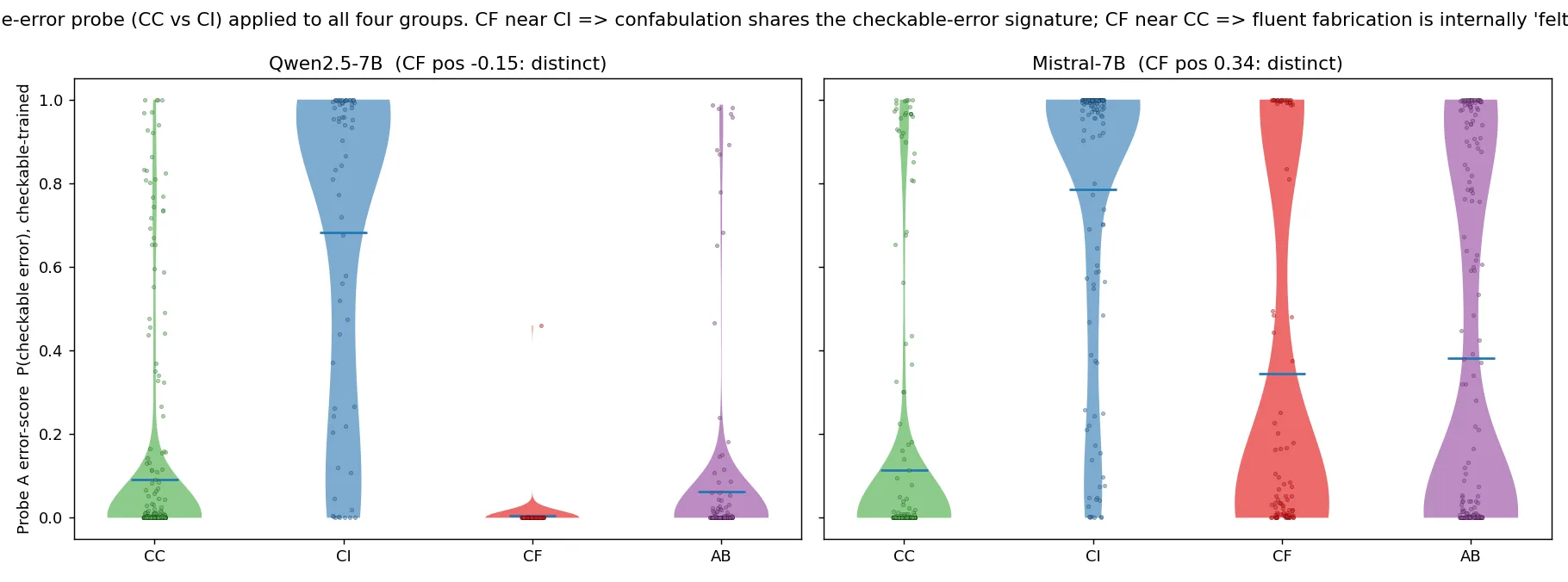
Linear probes on residual activations can read whether a model is about to answer incorrectly (Alain and Bengio, 2016) (Azaria and Mitchell, 2023) (Marks and Tegmark, 2024), and internal representations can encode truth even when the output does not (Burns et al., 2023) (Kadavath et al., 2022). We ask whether an error-awareness probe trained only on deterministic, objectively scorable mistakes also fires when a model confabulates, inventing a confident answer for an entity that does not exist, or whether fluent fabrication occupies a distinct internal direction. Across three instruct models, Llama 3.1 8B (Grattafiori et al., 2024), Qwen2.5 7B (Yang et al., 2024) and Mistral 7B (Jiang et al., 2023), we collect checkable items (arithmetic and capital-city questions split into correct, CC, and genuinely wrong, CI) and confabulation items (fake-entity prompts with no true answer, split into confident fabrication, CF, and abstention, AB, on the identical prompt). A checkable-error probe (CC versus CI) is strongly decodable, AUC 0.8707, 0.9057 and 0.9346, yet it does not transfer to confabulation: scoring CF against AB it reaches only 0.3404 on Qwen, below chance, and 0.5617 on Mistral, at chance (Hendrycks and Gimpel, 2017). The reason is that confabulation reads as felt-correct, cleanest on Qwen: there the mean error-score of CF is 0.0041, below even correct answers (CC 0.0910) and far below genuine errors (CI 0.6823), so the model registers its fabrications as more correct than its real correct answers, whereas on Mistral CF sits at 0.3441, above CC (0.1144) but still far below CI (0.7854). A within-fake-entity probe (CF versus AB), which holds the fake-entity prompt constant (CH-Wang et al., 2024) (Ji et al., 2023), separates the two responses near-perfectly, AUC 0.9873 and 0.9780, holding within the book and person entity types that actually confabulate; but a real-control test rescopes what it reads. Genuine confident naming of real entities (RC) projects onto this axis exactly where fabrication does (RC versus AB AUC 0.9920 and 0.9960, CF versus RC only 0.6814 and 0.3296), so the axis decodes a committed specific answer against an abstention and is only partly fabrication-specific. A cross-probe matrix shows a double dissociation, the error probe fails on confabulation and the confabulation probe fails on checkable error (Qwen 0.1334), and the two probe directions are near-orthogonal at every layer (cosine magnitude at most 0.0635). The clean dissociation is strongest in Qwen and only partial in Mistral, where the error probe pushes CF partway toward the error signature (CF versus CC AUC 0.8330) and the confabulation direction carries some error signal (0.7381). The practical implication is that an error-detector built on checkable wrongness is not, on its own, a confabulation detector (Park et al., 2024) (Pacchiardi et al., 2024), and the obvious within-fake-entity probe largely tracks answering against abstaining rather than fabrication, so a fabrication-specific signal still has to be isolated (Manakul et al., 2023) (Kuhn et al., 2023).
Setup
For each model we run two families of prompts. Checkable items are arithmetic and capital-city questions that have an objective answer; the model’s response is scored automatically into checkable correct (CC) and checkable incorrect (CI), the genuine task errors. Confabulation items name a non-existent country, book, person or place, so there is no true answer; the model either invents a confident answer (confident fabrication, CF) or refuses and says the entity does not exist (abstention, AB). Because CF and AB are responses to the same fake-entity prompts, the CF-versus-AB contrast holds the prompt constant and isolates fabrication from prompt-weirdness and out-of-distribution effects, the key control adopted from the sibling sandbagging study. A real-control group (RC) of genuine entities of the same types checks that the fakes are not simply unanswerable, and serves below as the matched specific-real-answer group for the answer-specificity control of Probe C. Answering is direct, with no chain of thought (Turpin et al., 2023) (Lanham et al., 2023), so the final pre-answer token carries the committed decision; we read the residual stream at that token across seven layers per model. All probes are L2 logistic regressions on standardized features with the scaler fit on train folds only, seed 42, scored by ROC-AUC on pooled out-of-fold predictions of a 5-fold stratified split, with 95% confidence intervals from 1000 bootstraps and the layer chosen by cross-validation on training data only (Belinkov, 2022). Probe A is the checkable-error detector (CC versus CI), Probe C is the within-confabulation detector (CF versus AB), and transfer asks whether Probe A, refit on all checkable rows, separates CF from AB and from CC.
Probe metrics
| model | probe | task | layer | AUC | ci_lo | ci_hi | Cohen d |
|---|---|---|---|---|---|---|---|
| llama-3.1-8b-instruct | A_CCvsCI | CC_vs_CI | 8 | 0.8707 | 0.8233 | 0.9116 | 1.4612 |
| qwen2.5-7b-instruct | A_CCvsCI | CC_vs_CI | 14 | 0.9057 | 0.8591 | 0.9440 | 2.2168 |
| qwen2.5-7b-instruct | C_CFvsAB | CF_vs_AB | 28 | 0.9873 | 0.9740 | 0.9968 | 4.7292 |
| mistral-7b-instruct-v0.3 | A_CCvsCI | CC_vs_CI | 24 | 0.9346 | 0.9105 | 0.9566 | 2.1741 |
| mistral-7b-instruct-v0.3 | C_CFvsAB | CF_vs_AB | 32 | 0.9780 | 0.9581 | 0.9924 | 4.2490 |
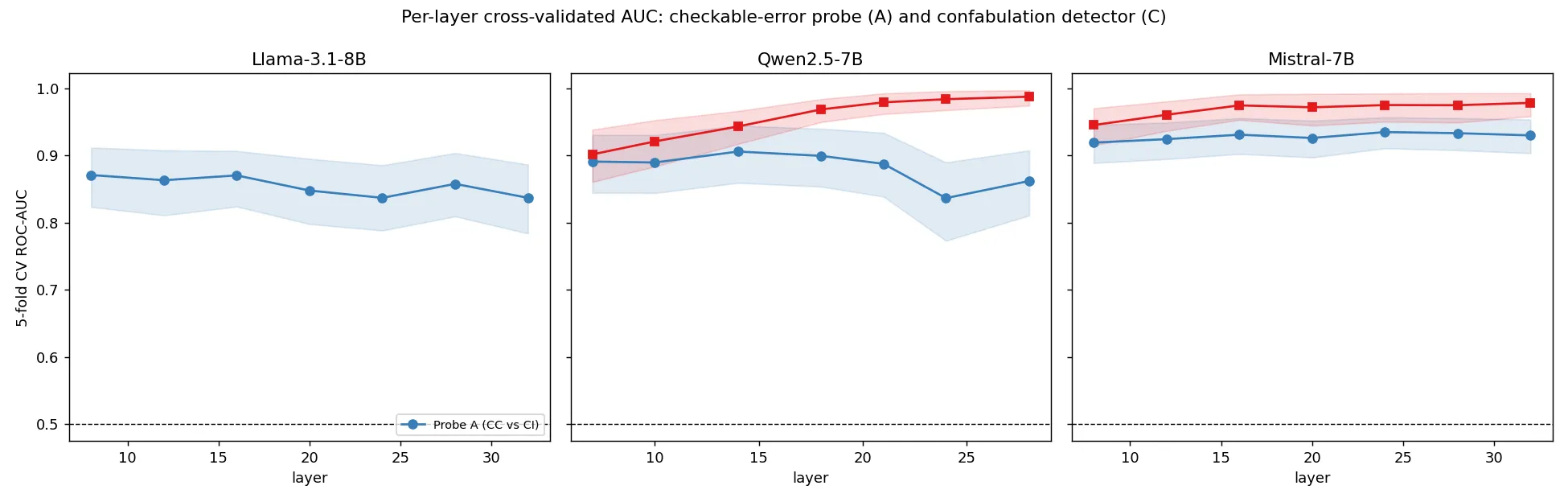
A deterministic checkable-error probe is linearly decodable in every model: Probe A reaches AUC 0.8707 on Llama (layer 8, 68 errors against 332 correct, Cohen d 1.46), 0.9057 on Qwen (layer 14, 65 against 335, d 2.22) and 0.9346 on Mistral (layer 24, 139 against 261, d 2.17), squarely in the error-awareness range (Kadavath et al., 2022). Probe C, the within-confabulation detector, is far stronger still, AUC 0.9873 on Qwen (layer 28, 113 fabrications against 187 abstentions, d 4.73) and 0.9780 on Mistral (layer 32, 100 against 200, d 4.25). The signal for the model is making this up exists and is almost perfectly separable, but, as the next sections show, it lives on its own axis. Llama is omitted from the confabulation probe because it abstains on nearly every fake entity (CF = 1), making it the abstainer baseline rather than a confabulator; the real-control answer rate is 1.0 for all three models, so the fakes are not merely unanswerable.
The checkable-error probe does not transfer to confabulation
| model | A on CF vs AB | ci_lo | ci_hi | A on CF vs CC | ci_lo | ci_hi | d(CF,CC) | d(CF,CI) | CF position (CC=0, CI=1) |
|---|---|---|---|---|---|---|---|---|---|
| qwen2.5-7b-instruct | 0.3404 | 0.2849 | 0.3978 | 0.2627 | 0.2182 | 0.3078 | -0.4229 | -2.8565 | -0.1469 |
| mistral-7b-instruct-v0.3 | 0.5617 | 0.4985 | 0.6246 | 0.8330 | 0.7905 | 0.8732 | 0.6854 | -1.1472 | 0.3424 |
Refit on all checkable rows at its best layer and applied to the confabulation rows, Probe A cannot pick fabrications out from abstentions. Its CF-versus-AB AUC is 0.3404 on Qwen, below chance, and 0.5617 on Mistral, at chance. The four-group error-score distribution explains why. On Qwen the mean error-score is 0.0910 for CC, 0.6823 for CI, 0.0041 for CF and 0.0630 for AB: confabulations score essentially zero, lower than the model’s own correct answers, so on the error axis a fabrication looks more correct than a genuine correct answer. The placement is captured by the CF position metric, which puts CF at -0.1469 on a scale where CC is 0 and CI is 1, below the correct-answer anchor, and by the large negative effect size against genuine errors, d(CF,CI) = -2.8565. On Mistral the fake-entity prompt elevates both CF and AB on the error axis (means 0.3441 and 0.3819) but to the same level, well below CI (0.7854): the prompt raises the error-score equally for fabricating and for abstaining, so fabrication itself is invisible to the error axis (CF-versus-AB 0.5617). Confabulation does not share the checkable-error signature; fluent fabrication is internally felt-correct, consistently across both models that confabulate, with the caveat that on Mistral the error probe does push CF partway toward the error region relative to correct answers (CF-versus-CC AUC 0.8330, d(CF,CC) = +0.6854), so the felt-correct reading is cleanest on Qwen. The error-score distributions across all four groups are shown in the main figure.
The underlying four-group error-score statistics, the data plotted in the main figure, are given below for each confabulating model, with group sizes, means, medians and 95 percent bootstrap confidence intervals.
| Model | Group | n | Mean | Median | CI low | CI high |
|---|---|---|---|---|---|---|
| Qwen2.5 7B | CC | 335 | 0.0910 | 0.0000 | 0.0694 | 0.1177 |
| Qwen2.5 7B | CI | 65 | 0.6823 | 0.9405 | 0.5903 | 0.7711 |
| Qwen2.5 7B | CF | 113 | 0.0041 | 0.0000 | 0.0000 | 0.0123 |
| Qwen2.5 7B | AB | 187 | 0.0630 | 0.0000 | 0.0355 | 0.0959 |
| Mistral 7B | CC | 261 | 0.1144 | 0.0001 | 0.0802 | 0.1504 |
| Mistral 7B | CI | 139 | 0.7854 | 0.9911 | 0.7238 | 0.8433 |
| Mistral 7B | CF | 100 | 0.3441 | 0.0517 | 0.2602 | 0.4311 |
| Mistral 7B | AB | 200 | 0.3819 | 0.0405 | 0.3242 | 0.4410 |
A double dissociation between the two axes
| model | A on CC vs CI | A on CF vs AB | C on CF vs AB | C on CC vs CI |
|---|---|---|---|---|
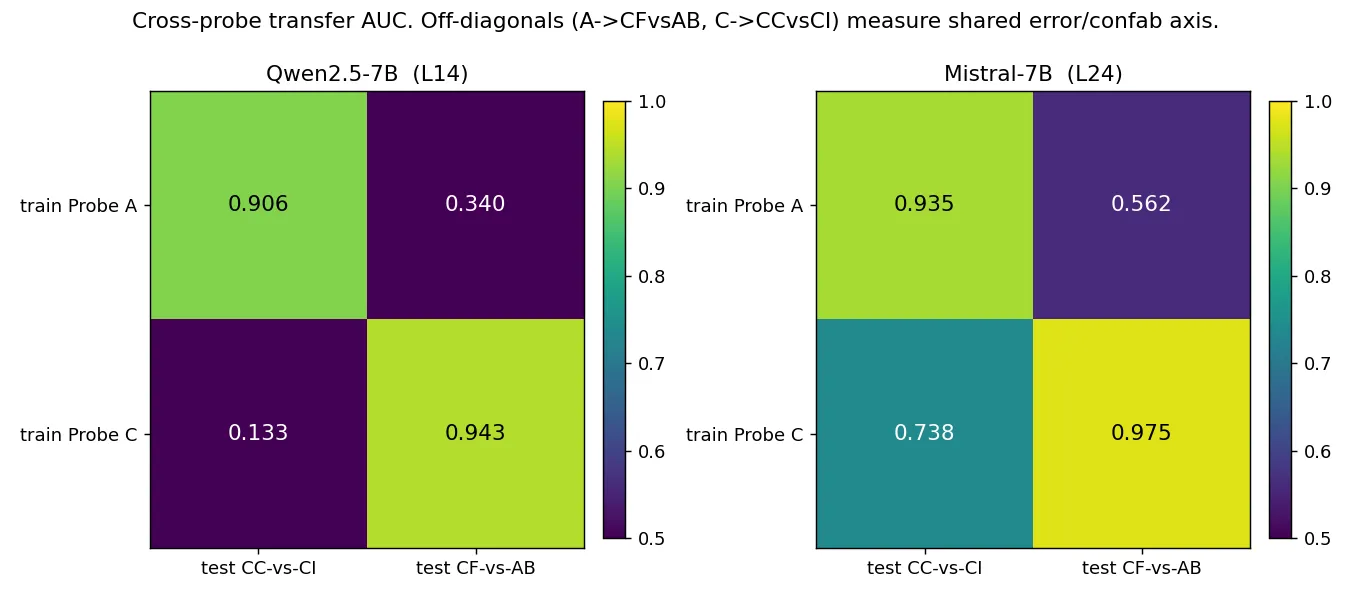
| qwen2.5-7b-instruct (L14) | 0.9057 | 0.3404 | 0.9429 | 0.1334 |
| mistral-7b-instruct-v0.3 (L24) | 0.9346 | 0.5617 | 0.9748 | 0.7381 |
Evaluated at a common layer, the cross-probe matrix shows a double dissociation. The error probe is strong on its own task and weak off it (Qwen 0.9057 on CC-versus-CI, 0.3404 on CF-versus-AB), and the confabulation probe is strong on its own task and weak off it (Qwen 0.9429 on CF-versus-AB, 0.1334 on CC-versus-CI, far below chance). Each probe fails on the other’s contrast, so the two are reading different internal features rather than one shared wrongness signal seen twice. The dissociation is clean on Qwen and only partial on Mistral, where the confabulation direction carries a moderate amount of error signal at this common layer (C on CC-versus-CI 0.7381), hinting at a partial shared sub-component in that model. The per-layer AUC curves for both probes are shown below, and the cross-probe transfer is summarized as a heatmap.
Confabulation is near-perfectly decodable on its own axis, and the axes are near-orthogonal
| model | entity subset | n CF | n AB | AUC book+person | ci_lo | ci_hi | full AUC |
|---|---|---|---|---|---|---|---|
| qwen2.5-7b-instruct | book+person | 100 | 60 | 0.9887 | 0.9705 | 1.0000 | 0.9873 |
| mistral-7b-instruct-v0.3 | book+person | 96 | 64 | 0.9797 | 0.9618 | 0.9925 | 0.9780 |
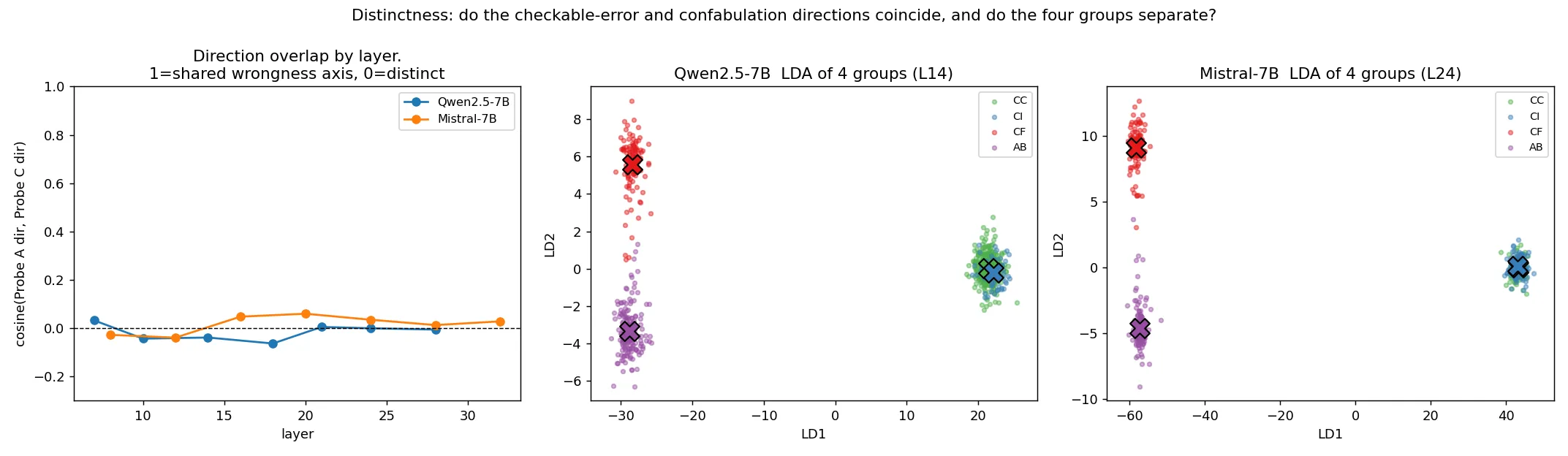
Because CF and AB share the fake-entity prompt, the near-perfect Probe C separation is not an artifact of prompt-weirdness; it is a robust signal read under a matched prompt control, though the real-control test in the next section shows it tracks committed answering rather than fabrication specifically. The signal is also not an artifact of mixing entity types: restricted to the book and person entities that actually confabulate, Probe C holds at full strength, AUC 0.9887 on Qwen and 0.9797 on Mistral, essentially the full-data values. The fake-country and fake-place items yield too few fabrications per model to test in isolation, so the confabulation result is demonstrated for the entity types that confabulate. Finally, the two probe directions are geometrically distinct. The cosine similarity between the checkable-error weight vector and the confabulation weight vector, both refit on full data at each layer, ranges from -0.0635 to 0.0321 on Qwen and from -0.0393 to 0.0598 on Mistral, near zero at every layer. The checkable-error direction and the confabulation direction are close to orthogonal, not the same wrongness direction read two ways. The cosine-by-layer curve and a two-dimensional projection of the four groups make the geometry visible.
A real-control test rescopes the within-fake-entity probe
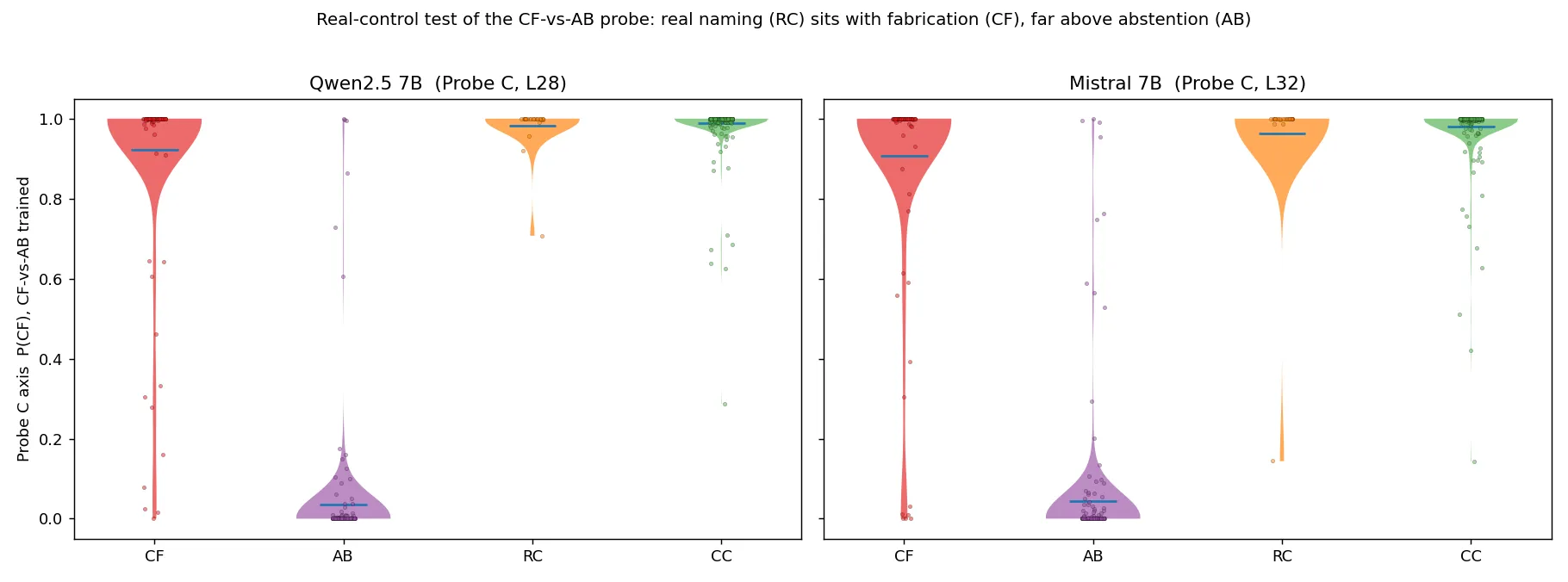
The CF-versus-AB probe holds the fake-entity prompt constant, but it does not hold the response type constant: CF is a committed specific answer and AB is an abstention. Its near-perfect separation could therefore read committed-answer-versus-abstention rather than fabrication as such. We settle this with the real-control group RC, in which the model confidently names a genuine entity of the same types (answer rate 1.0, n = 24 per model), the matched specific-real-answer group. Refitting Probe C exactly as before at its chosen layer (Qwen 28, Mistral 32) and projecting all four groups onto its decision axis, real confident naming lands with fabrication, not with abstention. On Qwen the mean axis score is 0.9224 for CF, 0.9819 for RC and 0.9890 for CC, against 0.0346 for AB; on Mistral it is 0.9078 for CF, 0.9631 for RC and 0.9809 for CC, against 0.0443 for AB. The decisive contrasts confirm it: the probe separates real naming from abstention essentially perfectly (RC-versus-AB AUC 0.9920 on Qwen, 0.9960 on Mistral) yet barely separates fabrication from real naming (CF-versus-RC AUC 0.6814 on Qwen, and 0.3296 on Mistral, below chance because real names score even higher than fabrications). The CC group, large specific answers from the arithmetic and capital domain, sits at the same high end (0.9890 and 0.9809), reinforcing the reading with the caveat that CC is a different domain. The within-fake-entity probe is therefore largely a committed-answer-versus-abstention axis and only partly fabrication-specific. With RC at only 24 items per model its mean confidence interval is wide (0.9540 to 0.9991 on Qwen, 0.8913 to 0.9998 on Mistral), so we do not overclaim the exact ordering of RC against CF; the robust fact is that RC sits with the committed-answer groups and far from abstention. This does not touch the paper’s main result, which rests on the checkable-error probe failing to transfer and on the near-orthogonal directions, but it narrows what the CF-versus-AB probe should be called.
| Model | Group | Mean P(CF) | CI low | CI high |
|---|---|---|---|---|
| Qwen2.5 7B | CF | 0.9224 | 0.8739 | 0.9608 |
| Qwen2.5 7B | AB | 0.0346 | 0.0146 | 0.0563 |
| Qwen2.5 7B | RC | 0.9819 | 0.9540 | 0.9991 |
| Qwen2.5 7B | CC | 0.9890 | 0.9819 | 0.9946 |
| Mistral 7B | CF | 0.9078 | 0.8560 | 0.9526 |
| Mistral 7B | AB | 0.0443 | 0.0220 | 0.0719 |
| Mistral 7B | RC | 0.9631 | 0.8913 | 0.9998 |
| Mistral 7B | CC | 0.9809 | 0.9686 | 0.9898 |
| Model | Contrast | AUC | CI low | CI high |
|---|---|---|---|---|
| Qwen2.5 7B | RC vs AB | 0.9920 | 0.9786 | 0.9997 |
| Qwen2.5 7B | CF vs RC | 0.6814 | 0.5914 | 0.7677 |
| Mistral 7B | RC vs AB | 0.9960 | 0.9894 | 1.0000 |
| Mistral 7B | CF vs RC | 0.3296 | 0.1858 | 0.4834 |
Limitations
The central caveat is that the clean dissociation is strongest in Qwen and only partial in Mistral. On Mistral the checkable-error probe separates CF from CC at AUC 0.8330 with d(CF,CC) = 0.6854, so fabrications drift partway toward the error signature rather than sitting cleanly with correct answers as they do on Qwen, and the confabulation direction carries a moderate error signal at the common layer (C on CC-versus-CI 0.7381). The fully distinct story is therefore a Qwen result that holds only partially on Mistral, and we report both rather than averaging them away. Llama abstains on almost every fake entity (CF = 1), so the confabulation analyses rest on two models. The answer-specificity control rests on 24 real-control items per model, enough to place real naming firmly with the committed-answer groups and far from abstention but not to resolve its exact ordering against fabrication. Confabulation also concentrates in book and person items; fake-country and fake-place produce too few fabrications per model to test separately, so the result is established for the entity types that confabulate, not for all four. The activations are last-position residual stream at seven layers, read by last-token linear probes, so richer pooling, attention-head-level readouts or nonlinear probes might find structure the layer-level linear probe misses. The evidence comes from three instruct models in the seven-to-eight-billion range under direct single-letter answering, and whether the felt-correct result holds at larger scale, on generative tasks, or with reasoning traces is untested. The probes are read-only, so whether the confabulation direction causally controls fabrication, the natural follow-up by steering along Probe C, is open.
Conclusion
A checkable-error probe trained on deterministic arithmetic and capital-city mistakes does not, by itself, detect confabulation. It is strongly decodable on its own task (AUC 0.87 to 0.93) but at or below chance on fabrication (CF-versus-AB 0.3404 and 0.5617), because confabulation reads as felt-correct, scoring at or below correct answers on the error axis while genuine errors score high. A within-fake-entity probe, with the fake-entity prompt held constant, separates the committed fabrication from abstention near-perfectly (0.9873 and 0.9780) and holds within entity type, but a real-control test shows that this axis largely tracks committed answering versus abstaining rather than fabrication itself: genuine confident naming of real entities scores with fabrication, not with abstention (CF-versus-RC AUC 0.6814 and 0.3296, against RC-versus-AB 0.9920 and 0.9960). The cross-probe matrix shows a double dissociation between the error axis and this commitment axis, and the two directions are near-orthogonal at every layer. Fluent fabrication is internally distinct from checkable wrongness, cleanly in Qwen and partially in Mistral, which means that detecting fabrication for oversight requires a fabrication-specific signal rather than a repurposed error detector, and that signal is not delivered by the obvious within-fake-entity probe either (Park et al., 2024) (Kuhn et al., 2023) (Xiong et al., 2024) (Tian et al., 2023) (Lin et al., 2022) (Zou et al., 2023) (Li et al., 2023).
References
- [alain2016probes] Alain, Guillaume and Bengio, Yoshua (2016). Understanding Intermediate Layers Using Linear Classifier Probes. arXiv:1610.01644.Origin of the linear-probe methodology we use to read an error signal off residual activations.
- [belinkov2022probing] Belinkov, Yonatan (2022). Probing Classifiers: Promises, Shortcomings, and Advances. arXiv:2102.12452.Survey framing what a linear probe does and does not license us to claim about internal computation, which bounds our distinctness reading.
- [burns2023ccs] Burns, Collin and Ye, Haotian and Klein, Dan and Steinhardt, Jacob (2023). Discovering Latent Knowledge in Language Models Without Supervision. arXiv:2212.03827.Central prior that internal representations encode truth even when outputs do not; our felt-correct confabulation result is a regime where the internal state and the truth of the output come apart.
- [azaria2023internal] Azaria, Amos and Mitchell, Tom (2023). The Internal State of an LLM Knows When It's Lying. arXiv:2304.13734.Closest precedent for training a probe on hidden states to detect false statements; we test whether such an error probe extends to fluent fabrication and find it does not.
- [marks2024geometry] Marks, Samuel and Tegmark, Max (2024). The Geometry of Truth: Emergent Linear Structure in Large Language Model Representations of True/False Datasets. arXiv:2310.06824.Evidence that truth is linearly represented, motivating the last-token linear probes whose near-orthogonal directions we measure.
- [li2023iti] Li, Kenneth and Patel, Oam and Vi\'egas, Fernanda and Pfister, Hanspeter and Wattenberg, Martin (2023). Inference-Time Intervention: Eliciting Truthful Answers from a Language Model. arXiv:2306.03341.Shows truth-correlated directions are causally usable, supporting that each of our two probe directions reads a real internal feature.
- [zou2023repe] Zou, Andy and Phan, Long and Chen, Sarah and others (2023). Representation Engineering: A Top-Down Approach to AI Transparency. arXiv:2310.01405.Representation-reading framing within which our checkable-error and confabulation directions both sit.
- [chwang2024androids] CH-Wang, Sky and Van Durme, Benjamin and Eisner, Jason and Kedzie, Chris (2024). Do Androids Know They're Only Dreaming of Electric Sheep?. arXiv:2312.17249.Detects hallucination from internal states; our Probe C is a same-spirit internal detector, isolated against a prompt-matched abstention control.
- [kadavath2022know] Kadavath, Saurav and Conerly, Tom and Askell, Amanda and others (2022). Language Models (Mostly) Know What They Know. arXiv:2207.05221.Foundational self-evaluation result; our checkable-error probe is its internal analogue, and the confabulation failure marks where that self-knowledge does not surface.
- [hendrycks2017baseline] Hendrycks, Dan and Gimpel, Kevin (2017). A Baseline for Detecting Misclassified and Out-of-Distribution Examples in Neural Networks. arXiv:1610.02136.Establishes confidence-as-detector evaluation by AUC, the metric we apply to every probe and transfer test.
- [tian2023justask] Tian, Katherine and Mitchell, Eric and Zhou, Allan and others (2023). Just Ask for Calibration: Strategies for Eliciting Calibrated Confidence Scores from Language Models Fine-Tuned with Human Feedback. arXiv:2305.14975.Calibration-elicitation reference grounding the gap between a model's expressed confidence and the truth of its answer that confabulation exemplifies.
- [xiong2023canllms] Xiong, Miao and Hu, Zhiyuan and Lu, Xinyang and others (2024). Can LLMs Express Their Uncertainty? An Empirical Evaluation of Confidence Elicitation in LLMs. arXiv:2306.13063.Documents the overconfidence failure modes our confabulating models display when they invent answers to fake entities.
- [ji2023survey] Ji, Ziwei and Lee, Nayeon and Frieske, Rita and others (2023). Survey of Hallucination in Natural Language Generation. arXiv:2202.03629.Defines and taxonomizes hallucination; our confabulation items operationalize the intrinsic fabrication case with no ground-truth answer to hallucinate against.
- [manakul2023selfcheckgpt] Manakul, Potsawee and Liusie, Adian and Gales, Mark J. F. (2023). SelfCheckGPT: Zero-Resource Black-Box Hallucination Detection for Generative Large Language Models. arXiv:2303.08896.Black-box consistency-based hallucination detector; contrast to our white-box probe that reads fabrication directly from the residual stream.
- [lin2022truthfulqa] Lin, Stephanie and Hilton, Jacob and Evans, Owain (2022). TruthfulQA: Measuring How Models Mimic Human Falsehoods. arXiv:2109.07958.Benchmark for confident falsehoods; our fake-entity prompts induce the same confident-but-false behavior under a controlled no-true-answer design.
- [kuhn2023semantic] Kuhn, Lorenz and Gal, Yarin and Farquhar, Sebastian (2023). Semantic Uncertainty: Linguistic Invariances for Uncertainty Estimation in Natural Language Generation. arXiv:2302.09664.Semantic-entropy approach to detecting fabrication from output uncertainty; we instead detect it from internal geometry and show it is invisible to the checkable-error axis.
- [turpin2023saywhat] Turpin, Miles and Michael, Julian and Perez, Ethan and Bowman, Samuel R. (2023). Language Models Don't Always Say What They Think: Unfaithful Explanations in Chain-of-Thought Prompting. arXiv:2305.04388.Motivates direct single-letter answering with no chain of thought, so the pre-answer token carries the committed decision we probe.
- [lanham2023faithfulness] Lanham, Tamera and Chen, Anna and Radhakrishnan, Ansh and others (2023). Measuring Faithfulness in Chain-of-Thought Reasoning. arXiv:2307.13702.Faithfulness of stated reasoning to internal computation, the gap our probe-versus-output divergence on confabulation operationalizes.
- [pacchiardi2024liar] Pacchiardi, Lorenzo and Chan, Alex J. and Mindermann, S\"oren and others (2024). How to Catch an AI Liar: Lie Detection in Black-Box LLMs by Asking Unrelated Questions. arXiv:2309.15840.Black-box lie detection contrast to our white-box probes; both target the gap between truth and stated output.
- [park2024deception] Park, Peter S. and Goldstein, Simon and O'Gara, Aidan and Chen, Michael and Hendrycks, Dan (2024). AI Deception: A Survey of Examples, Risks, and Potential Solutions. arXiv:2308.14752.Frames the oversight stakes of a model that confidently fabricates, motivating a fabrication-specific detector rather than a generic error probe.
- [grattafiori2024llama3] Grattafiori, Aaron and Dubey, Abhimanyu and Jauhri, Abhinav and others (2024). The Llama 3 Herd of Models. arXiv:2407.21783.Model card for Llama-3.1-8B, the near-total abstainer that anchors the abstention baseline.
- [qwen2024qwen25] Yang, An and Yang, Baosong and Zhang, Beichen and others (2024). Qwen2.5 Technical Report. arXiv:2412.15115.Model card for Qwen2.5-7B, the model with the cleanest felt-correct confabulation signature.
- [jiang2023mistral] Jiang, Albert Q. and Sablayrolles, Alexandre and Mensch, Arthur and others (2023). Mistral 7B. arXiv:2310.06825.Model card for Mistral-7B-v0.3, the model whose confabulation result is partial rather than clean.